
Eagle Lawn Care mowing guide
How Often to Mow Your Lawn in Eagle, Idaho: A Season-by-Season Guide
Most Eagle lawns need mowing about once a week in spring and early summer, every 7 to 14 days during the July and August heat, and about weekly again in fall until growth stops. Those ranges are a starting point. The real trigger is grass height: University of Idaho Extension recommends the one-third rule, which means never removing more than one-third of the blade in a single mowing.
Call (208) 306-2702That rule is why a lawn can need mowing every five days in May and only every two weeks in August. This guide explains how to apply it, what height to mow at, how Eagle’s climate changes the schedule, and when it makes sense to hand the job to a professional.
Quick Summary
| Question | Short answer |
|---|---|
| How often should I mow in Eagle? | About weekly in spring and early summer; every 7 to 14 days in July and August; about weekly in fall until growth stops |
| What decides the timing? | Grass height. Mow before you would remove more than one-third of the blade |
| What height should I mow? | About 3 inches for a Kentucky bluegrass lawn (University of Idaho range: 2 to 3.5 inches). Never below 2 inches |
| Should I mow in the July heat? | Yes if the lawn is still growing, at a slightly higher setting. Not if the turf has gone dormant |
| When is the last mow? | When growth stops, often late October into November |
How to Know When It Is Time to Mow: The One-Third Rule
A calendar tells you when you usually mow. Your grass tells you when you actually should. The one-third rule turns that idea into a number you can check.
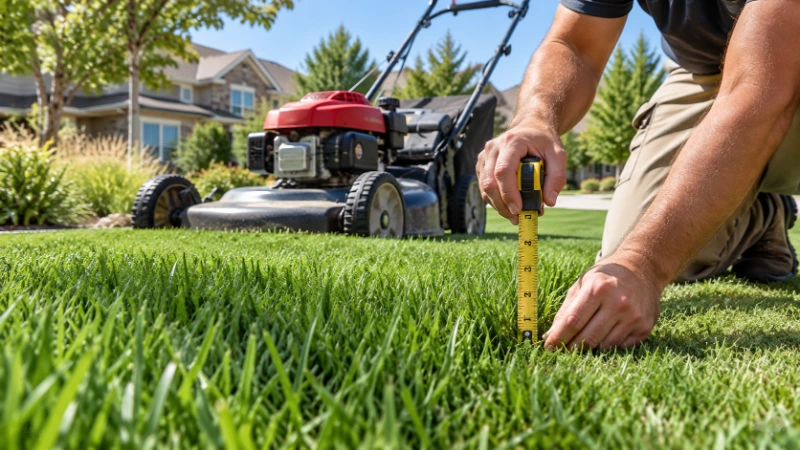
Cut too much at once and the grass loses leaf area it needs to make food, which weakens roots and leaves the lawn open to stress and weeds. Cut a little at a time and the lawn stays dense. University of Idaho Extension gives a simple example: with the mower set at 3 inches, mow when the grass reaches 4.5 inches.
The formula is easy to reuse:
Mowing trigger height = your mower setting × 1.5| Mower setting | Mow when grass reaches | Amount removed |
|---|---|---|
| 2 inches | 3 inches | 1 inch |
| 2.5 inches | 3.75 inches | 1.25 inches |
| 3 inches | 4.5 inches | 1.5 inches |
| 3.5 inches | 5.25 inches | 1.75 inches |
| 4 inches | 6 inches | 2 inches |
A quick weekly check works well. Push a ruler into the turf in a few spots and measure the standing grass. If it is at or near the trigger height, mow. If it is well below, wait. This is what “growth, not calendar” means in practice, and it settles most weekly-versus-bi-weekly arguments.
What Height Should You Mow in Eagle?
Height matters as much as frequency, and it is also where most lawn mistakes happen.
University of Idaho Extension puts Kentucky bluegrass at 2 to 3.5 inches, with 3 inches a good target for home lawns and nothing below 2 inches. Many Eagle lawns are Kentucky bluegrass or a mix that includes perennial ryegrass, tall fescue or fine fescue, so treat 3 inches as a sensible default and adjust if you know your grass type.
Why Taller Grass Is Usually Better
Higher mowing encourages deeper roots and shades the soil, which helps in a dry climate with hot summers. Cutting very short does the opposite. Short grass has shallower roots, dries out faster and gives weeds more room to start.
Does Mowing Short Mean Mowing Less Often?
No. This is a common misconception. A lower setting does not slow growth; it just removes more of the leaf each time. Scalping a lawn to stretch the gap between mows usually leads to stressed, thinner turf and more work later.
Summer Mowing Height
University of Idaho Extension recommends raising the mower a notch in summer. One wheel notch is roughly 1/4 inch. Many Treasure Valley lawn providers go further and suggest 3.5 to 4 inches in July and August. A reasonable approach is to use the University’s 3-inch baseline and raise it toward 3.5 inches or higher during the hottest weeks, especially on lawns that look stressed.
Do Not Lower the Height in Spring or Fall
Some local calendars suggest dropping the height as weather changes. University of Idaho Extension says lowering it in spring and fall is not necessary. Keep the setting steady and let frequency do the adjusting.
Eagle Mowing Schedule by Season
Eagle sits in USDA Zone 7a with a cold semi-arid climate. Annual rainfall is about 12 to 13 inches, the July average high is about 91 to 92°F, the last spring frost usually falls in late April and the first fall frost around mid-October. Those figures vary slightly by source and by year.
The key point is how cool-season lawns behave. University of Idaho Extension notes they grow fastest in spring and fall, when soil temperatures are about 55 to 65°F, and slower in summer. That growth curve is the backbone of any good schedule.
| Season | Approximate timing | Growth | Typical mowing frequency |
|---|---|---|---|
| Spring flush | Late April to May | Fast | Weekly; some providers mow every 4 to 5 days during the fastest growth |
| Early summer | June | Strong, then slowing | About weekly |
| Peak heat | July to August | Slow, sometimes dormant | Every 7 to 14 days, or not at all if dormant |
| Early fall rebound | September to early October | Picks up again | Often back to about weekly (typical practice, depends on growth) |
| Late fall | Mid-October into November | Slowing, then stops | Keep mowing until growth stops |
These frequencies reflect University of Idaho guidance on growth plus the ranges commonly given by Treasure Valley providers. Providers do not all agree, so use the table as a range and let the trigger height decide.
-
Spring: The First Mow and the Flush
The first mow of the year comes when the grass reaches your trigger height, which is typically after the last spring frost in late April. Spring is when lawns grow fastest, so skipping a week can push you past the one-third limit quickly. Weekly mowing is the norm, and a fast May may call for more often.
-
Early Summer: Still Weekly
Growth stays strong into June, particularly on lawns that are fertilized and well watered. The weekly rhythm usually continues until the heat arrives.
-
July and August: Slow Down, Raise the Deck
The hot season in Eagle runs from roughly mid-June to mid-September, and July is the driest month. Growth slows, so every 7 to 14 days is often enough. Raise the mower height and mow in the cooler part of the day.
-
Fall: Do Not Quit Early
Some providers suggest every 10 to 14 days in fall. University of Idaho Extension points the other way: cool-season grass grows rapidly again as soils cool, and mowing should continue late into fall, sometimes into late November. In practice, many lawns return to a weekly rhythm after the summer slowdown. Watch the grass, not the date.
-
The Last Mow of the Year
Mow until the grass stops growing. University of Idaho Extension prefers keeping the height the same and mowing more often over lowering it for winter. Several local providers suggest a final cut around 2 inches instead. Both approaches are common, but the University’s guidance is the safer baseline.
Weekly or Bi-Weekly Mowing: Which Is Better?
Both can work. The difference comes down to how fast the grass is growing and how tall it gets between mows.
| Factor | Weekly mowing works best when | Bi-weekly mowing can work when |
|---|---|---|
| Growth rate | Grass is growing fast (spring, early summer, fall) | Growth is slow (July and August) |
| Height at mowing time | Waiting longer would pass the trigger height | Grass is still at or below the trigger height after two weeks |
| Mower setting | Lower settings (2 to 2.5 inches) | Higher settings (3.5 inches or more) |
| Watering and feeding | Lawn is well watered and recently fertilized | Lawn is on a lean watering schedule |
| Risk if you wait | Removing more than one-third of the blade | Little, if the height check passes |
Bi-weekly mowing backfires most often in spring. A lawn that is allowed to double its height in a growth spurt has to be cut hard, which stresses the turf and leaves heavy clippings. If you want to mow less in summer, raise the setting and rely on the height check rather than simply skipping weeks.
What About July Heat, Drought and Dormant Grass?
Should You Mow Brown Grass in July?
If the grass is dormant, there is nothing to cut. Kentucky bluegrass can survive drought by going dormant, especially if it was healthy and well rooted beforehand, according to University of Idaho Extension. Dormant turf does not need mowing, and cutting it low while it is stressed can do real damage.
Before deciding, check whether the lawn is dormant, overwatered or has a different problem. Brown patch fungus, which tends to appear in July and August, often shows up on lawns that are overwatered. Yellowing in an otherwise green lawn can be iron chlorosis, which is common in southern Idaho’s high-pH soils and is not a mowing problem.
Coordinating Mowing With Irrigation
University of Idaho Extension gives general irrigation targets for the region: about 1 inch of water per week from April to mid-May, about 2 inches per week from late May to mid-August, and just over 1 inch per week from mid-August to late September. More water means faster growth, which means more mowing. If you cut back on watering, expect the mowing interval to stretch.
The 2026 Drought Emergency
Idaho declared a statewide drought emergency covering all 44 counties on April 13, 2026. As of this writing it runs through December 31, 2026 unless extended. The declaration does not itself set municipal outdoor watering schedules, so check with the City of Eagle or your irrigation provider for current rules before changing your watering. In a dry year, a taller setting and a willingness to let the lawn slow down in July are your best tools.
When Are You Allowed to Mow in Eagle?
Eagle City Code 4-9-3 sets noise limits. General quiet hours run from 10 PM to 8 AM. Landscape maintenance noise may begin at 7 AM Monday through Friday, and at 6 AM Monday through Friday in June, July and August. Because codes change, check the current ordinance with the city before relying on these hours. HOA landscape rules can add their own requirements, so check yours too.
In practice, mowing in the early morning or late afternoon is easier on the lawn in summer and on you.
What to Do If You Missed a Week (or Three)
A tall, overgrown lawn should not be cut back to normal height in one pass. Taking off too much at once is the main cause of scalping and yellowing.
University of Idaho Extension recommends mowing in stages:
- Set the mower to its highest setting and cut once.
- Lower the deck a notch or two and mow again at the next opportunity.
- Repeat in steps until you are back at your target height, which for a very tall lawn may mean working down from 6 inches toward 2 or 3 inches over several mows.
If the grass is wet or the clippings are clumping, wait for a dry day.
A Few Mowing Habits That Protect the Lawn
Leave the clippings. University of Idaho Extension says clippings do not cause thatch, and if you follow the one-third rule they return nutrients to the soil.
Keep blades sharp. Sharpen about every 4 to 6 weeks of mowing. Dull blades tear the grass, leaving ragged, browning tips.
Vary your pattern. Mow in a different direction each time to avoid ruts and grass leaning in one direction.
Mow dry grass. Wet grass clumps and cuts unevenly.
Should You Mow It Yourself or Hire Weekly Service?
If you enjoy the work and can check the grass height every week, DIY mowing is straightforward. The method above is all you need.
Hiring makes sense when the weekly rhythm is hard to keep up. Between travel, heat and a fast May, many homeowners fall behind exactly when the lawn is growing fastest. A recurring service solves the consistency problem and takes judgment calls off your plate, such as when to raise the deck in July or skip a dormant lawn. A weekly schedule typically means roughly 24 to 28 visits across a Treasure Valley season, according to one local company’s estimate.
A typical weekly visit includes mowing along with edging, trimming and blowing off hard surfaces, but scope varies by provider. Price depends on lot size, lawn condition, access, and whether extras are included, so ask for the specifics rather than comparing a single number.
If you would rather not track grass height every week, you can request mowing service from a local Eagle provider. When you reach out, ask which mowing height they use, how they handle July heat, and whether the schedule shifts as growth slows or returns.
Frequently Asked Questions
It is best to wait. Wet grass clumps, cuts unevenly and can clog the mower, so mow once it has dried.
Yes. Varying the pattern prevents ruts and helps grass stand up evenly.
University of Idaho Extension suggests about every 4 to 6 weeks of mowing. Dull blades tear the grass rather than cutting it cleanly.
University of Idaho Extension says to mow when the seedlings are just past your desired height. It also advises waiting until the lawn has been mowed about four times before applying herbicide.
Check your HOA’s landscape guidelines. They may set height limits or schedules in addition to city rules.
The Bottom Line
For an Eagle lawn, the best mowing schedule follows growth. Mow when the grass reaches 1.5 times your setting, keep the height around 3 inches (higher in the July heat), and keep going in fall until the lawn stops growing. Use weekly mowing as the default in spring and fall, stretch to every 7 to 14 days in the heat, and skip dormant grass entirely.
If keeping up with that rhythm is more than you want to take on, a local Eagle mowing provider can handle the weekly routine so the lawn stays at the right height all season.
Need help keeping up with weekly mowing in Eagle?
Call Eagle Lawn Care to ask about mowing service for your Eagle, Idaho lawn.
Call (208) 306-2702