
When to Fertilize Your Lawn in Ada County, Idaho: A Seasonal Timing Guide
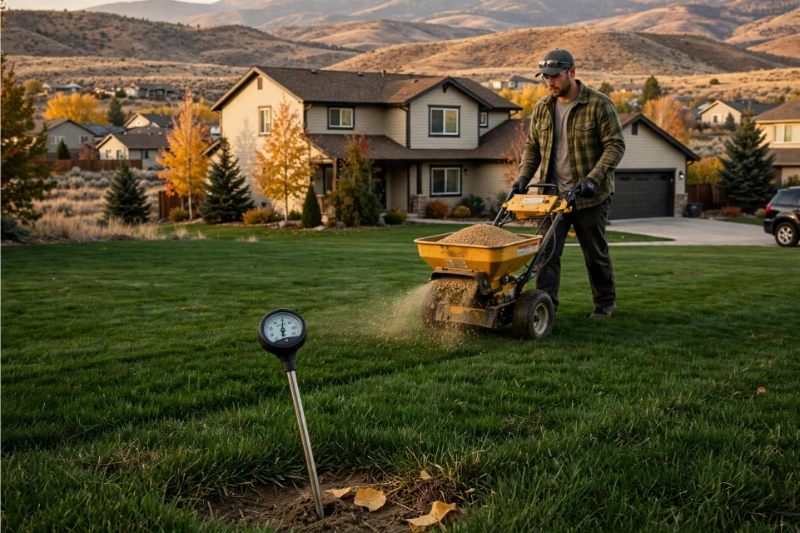
If you’re wondering when to fertilize your lawn in Ada County, the short answer is this: fertilize once soil temperature reaches about 55°F in spring, apply again in early fall when soil temperature drops back through roughly 50°F, and treat that fall application as the one that matters most. A full program generally runs three to four applications a year, timed to soil temperature and the area’s frost dates rather than to a fixed calendar date.
That’s the core answer. The rest of this guide explains why soil temperature — not the date on your calendar or the air temperature outside — is the real trigger, how Ada County’s high-desert climate shapes that timing, and what changes (or doesn’t) if you’re growing Kentucky bluegrass versus tall fescue.
Why Soil Temperature, Not the Calendar, Decides Timing
The question behind every fertilizer schedule — when to fertilize your lawn in Ada County — has a soil-temperature answer, not a calendar answer. Most national lawn-care advice tells you to fertilize “in spring” or “in fall” without giving you a way to check whether your lawn is actually ready. That’s a problem in a climate like Ada County’s, where spring soil temperature often lags two to three weeks behind the calendar. Fertilizing in mid-March because a bag of fertilizer or a generic article says “spring” can mean feeding grass roots that haven’t woken up yet — the nitrogen either washes away, feeds weeds more than your lawn, or just sits unused.
Soil temperature tells you what the grass plant is actually doing. Here’s the general pattern for cool-season lawns in this region:
- Around 50°F: Roots are beginning to wake up in spring, but it’s still too early to fertilize.
- Around 55°F: The spring fertilizer window opens.
- Around 65°F: Spring-formula fertilizing should taper off as the lawn shifts into faster, warmer-season growth.
- Around 50°F (falling): The fall fertilizer window opens as temperatures drop.
- Around 40°F: Stop fertilizing — the grass is heading into dormancy and won’t use the nutrients effectively.
You don’t need special equipment to track this — a basic soil thermometer works, and free tools like the GreenCast soil temperature tool show current soil temperatures by ZIP code. These numbers come from regional fertilization-calendar data for the Boise area, not from a single official source — treat them as practical regional guidance rather than an exact science, and always check them against your specific product’s label.
Ada County’s Climate: Why Timing Looks Different Here
Ada County and the broader Treasure Valley sit in a high-desert climate — hot, dry summers with low humidity, and a defined frost season that roughly bookends the fertilizing year. Local frost dates are typically cited as around April 15 for the last spring frost and around October 15 for the first fall frost. Those frost dates line up closely with the soil-temperature windows above, which is part of why they’re useful planning anchors even though frost date and soil temperature aren’t the same measurement. It’s also why when to fertilize your lawn in Ada County can shift by two or three weeks from one spring to the next — the soil, not the calendar, moves first.
The area’s irrigation calendar tells a similar story. Local pressurized irrigation generally runs from around mid-April through early October — nearly the same window as the fertilizing season. That overlap matters practically, not just coincidentally: watering in fertilizer after application helps move nutrients to the root zone, and timing an application near the start of your watering cycle (rather than right before a dry stretch) makes it more effective.
Why Fall Is the Most Important Application
Spring, summer, and fall fertilizer applications don’t carry equal weight. If you remember only one rule about when to fertilize your lawn in Ada County, make it this one: never skip the early fall application.
Here’s why: during late summer into fall, cool-season grasses like Kentucky bluegrass and tall fescue shift their energy from visible top growth into root development. That root growth is what carries a lawn through winter dormancy and sets it up to green up strong the following spring — not the amount of fertilizer it got back in March. An early fall application, timed to soil temperature dropping through roughly 50°F and landing a few weeks before the first frost (commonly framed as two to six weeks ahead of that mid-October date), feeds that root-building process directly.
A spring application still has a role — it supports green-up and early-season density — but it’s the supporting act, not the headliner. If your current routine only includes a spring application and skips fall, that’s a common and fixable timing mistake, not a sign you need a completely different approach.
When to Fertilize Your Lawn in Ada County: The Seasonal Breakdown
| Window | When It Opens | What It’s For |
|---|---|---|
| Spring | Soil temperature reaches about 55°F (often lagging mid-to-late April in this region) | Supports green-up and early-season density |
| Late Spring / Early Summer | Soil temperature approaches 65°F | Tapering off spring-formula feeding as growth speeds up |
| Summer | — | Generally avoided; see below |
| Early Fall | Soil temperature drops back through about 50°F | The most important application — builds root strength ahead of winter |
| Late Fall | Soil temperature nearing 40°F | Final application before dormancy, if your program includes one |
Put together, this table is the practical answer to when to fertilize your lawn in Ada County: a three-to-four-application framework commonly cited for a full cool-season lawn program in this region — spring, early fall, and sometimes a late-spring and/or late-fall application depending on your lawn’s needs and product choice.
Should You Fertilize in Summer?
The safest short answer for when to fertilize your lawn in Ada County in summer is: mostly, don’t — or at least, be cautious about it. Ada County summers bring real heat stress to cool-season lawns, and fertilizing heavily during extended hot stretches (commonly described as five or more consecutive days above 90°F) can do more harm than good. Heat-stressed grass isn’t actively growing the way it does in spring and fall, so added nitrogen is more likely to stress the lawn further or go to waste than to help it.
If you fertilized in July and your lawn looked worse afterward rather than better, timing — not necessarily the product — is a likely explanation. That’s a specific, climate-driven caution for this region, not a generic “avoid summer” warning that applies everywhere equally.
Does Grass Type Change the Timing?
Not fundamentally — but it’s worth knowing what you’re growing. Kentucky bluegrass is the dominant cool-season lawn grass in the Boise area, with tall fescue and fine fescue also common. Both follow the same soil-temperature-driven timing described above, with fall remaining the priority application for either one.
The main practical difference: tall fescue’s deeper root system makes it somewhat more forgiving of timing variance than bluegrass. That doesn’t mean timing stops mattering for fescue lawns — it just means a slightly mistimed application is less likely to cause visible stress compared to bluegrass. If you’re not sure which grass type you have, a local provider can typically identify it on a visit, and it doesn’t change the overall seasonal framework enough to require a different calendar. Whichever grass you’re growing, the priority order for when to fertilize your lawn in Ada County stays the same — fall first, spring second, summer last.
Matching General Guidance to Your Fertilizer’s Label
Everything above describes general timing principles for this region — when the lawn is ready to use fertilizer effectively. Your specific product still has its own label, and that label is what should set the exact rate and any product-specific timing notes (like whether it’s formulated for spring green-up, summer stress, or fall root-building). A general calendar tells you when fertilizing makes sense; the label tells you how much to put down and whether that particular formula is meant for the window you’re in. When the two seem to conflict — for example, a product marketed heavily for spring that you’re applying in early fall — follow the label’s intended use rather than assuming any fertilizer works the same at any time of year.
Regional guidance backs this approach: the University of Idaho Extension’s Southern Idaho lawns guide recommends 3 to 5 pounds of actual nitrogen per 1,000 square feet per year for lawns in this part of the state, split across the season’s applications rather than applied all at once.
It’s also worth noting that even locally focused fertilization calendars aren’t always internally consistent — some reference different nitrogen ratios in different sections, or mix in guidance meant for warm-season grasses that don’t apply here. A 4-1-2 nitrogen-to-phosphorus-to-potassium ratio (for example, something like a 20-5-10 or 32-8-16 product) is commonly recommended for cool-season grasses like Kentucky bluegrass in this region, but your label is the final word for your specific product.
Common Timing Mistakes
Almost every mistake around when to fertilize your lawn in Ada County comes down to timing, not product choice. A few patterns show up repeatedly among Ada County homeowners managing their own fertilizer schedule:
- Fertilizing by the calendar instead of soil temperature — applying in mid-March because “spring” has technically started, before the soil has actually warmed up.
- Treating all four seasonal windows as equally important — and as a result, skipping or shortchanging the fall application, which matters most.
- Fertilizing during extended summer heat stress — assuming more nitrogen will fix a stressed lawn when the real issue is heat and water, not nutrients.
- Not checking the product label against the season — using a spring-formulated product in fall, or vice versa.
- Fertilizing right before a dry stretch instead of ahead of watering, missing the benefit of watering the application into the root zone.
FAQ
Light rain shortly after application can help water in fertilizer similarly to irrigation. Heavy rain, especially right after applying, risks washing fertilizer off the lawn before it’s absorbed — it’s generally better to apply when a moderate watering (by rain or irrigation) is expected within a day or so, not during a downpour.
Many homeowners fertilize shortly after mowing, once clippings have been cleared, so the fertilizer reaches the soil rather than sitting on top of cut grass. Avoid mowing again immediately afterward — give the lawn a few days before the next cut. Getting the pairing right also depends on keeping the correct mowing height for Treasure Valley lawns and knowing how often to mow your lawn during peak growth, so timing and clippings work together instead of against each other.
Three to four applications is the commonly cited framework for when to fertilize your lawn in Ada County across a full season: a spring application, the priority early-fall application, and optionally a late-spring and/or late-fall round depending on your lawn and product.
It can be. If you fertilized before soil temperature reached roughly 55°F in spring, or during a summer heat-stress stretch, the grass may not have been in a state to use the nitrogen effectively. Timing is one of the more common, fixable explanations for a fertilizer application that doesn’t seem to be working.
Not necessarily. The timing principles here are straightforward once you know them, but checking soil temperature and adjusting around weather through the season is ongoing work. If that kind of tracking isn’t something you want to manage yourself, a local lawn fertilization provider that already times applications around Ada County’s seasonal patterns can take that off your plate.
Conclusion
Deciding when to fertilize your lawn in Ada County comes down to one shift in thinking: let soil temperature and the local frost calendar set your schedule, not a fixed date or a one-size-fits-all national calendar. Treat the early fall application as the one that matters most, use spring to support it, and hold off during summer heat stress. If you’d rather not track soil temperature and seasonal windows yourself, a lawn fertilization service that times applications to Ada County’s patterns can manage the timing and the application for you.