
EAGLE LAWN CARE · LAWN CARE GUIDE
Why Is My Lawn Turning Brown in Summer in Eagle, Idaho? Causes, Prevention, and Lawn Care Solutions
A lawn turning brown in summer is a symptom, not a diagnosis — this guide runs four quick checks to find the real cause before you treat anything.
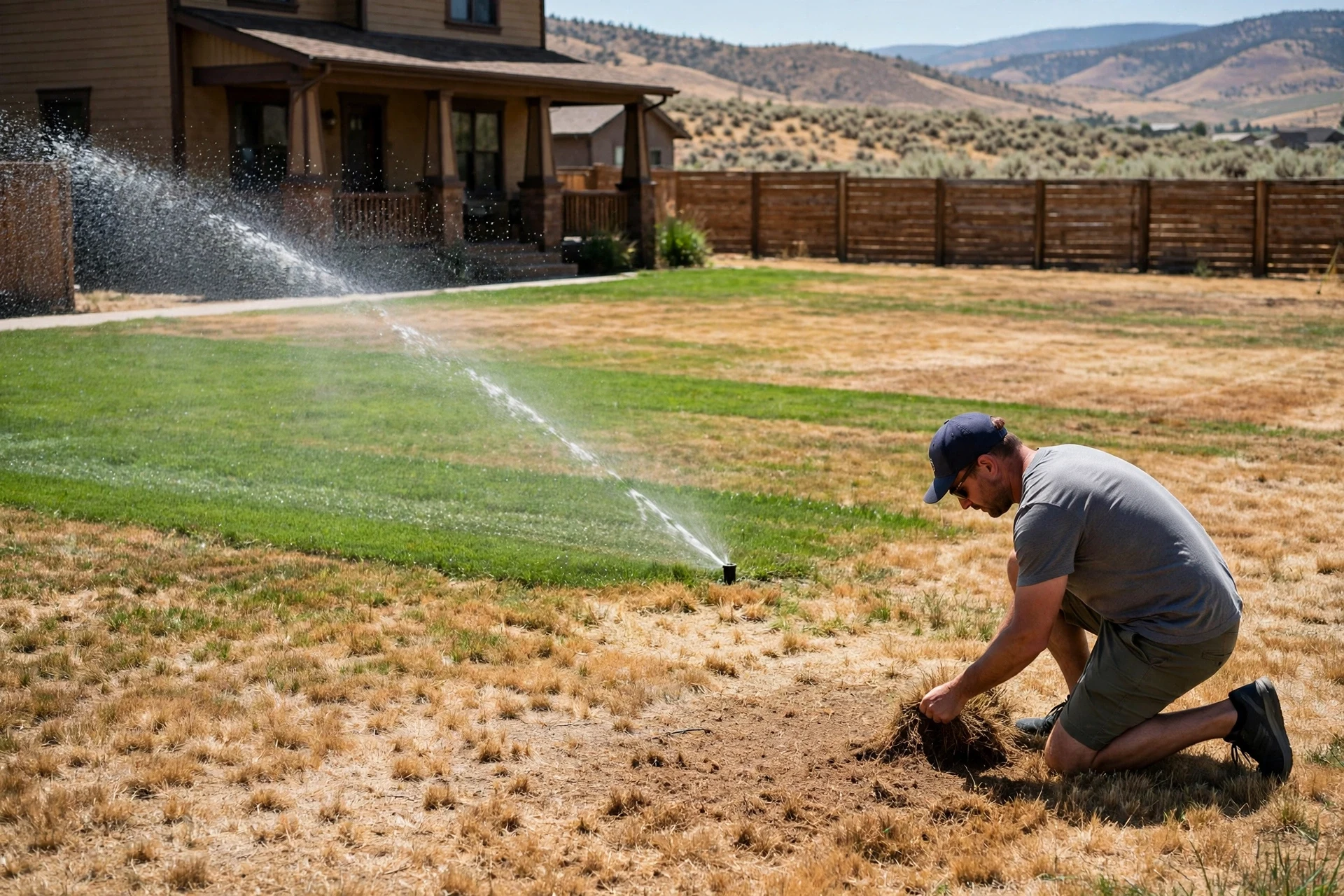
A lawn turning brown in summer in Eagle, Idaho usually comes down to heat and water stress, but not always. Dormancy, a sprinkler problem, billbugs, disease, compacted soil or mowing habits can all look much the same from the porch. Brown also doesn’t automatically mean dead. Cool-season grass can go dormant in hot, dry weather and recover.
The fastest way to find the cause is to run four quick checks before you treat anything: read the pattern, test the soil, tug the grass, and walk your sprinklers. This guide walks through them, helps you match the results to a likely cause, and explains what to do next.
Is It Dead or Dormant?
Kentucky bluegrass, tall fescue and other cool-season grasses grow best in moderate temperatures. University of Idaho Extension notes they grow best between about 50 and 75°F and respond to higher temperatures by going dormant and turning temporarily brown. Extension sources outside Idaho describe dormancy as a natural survival mechanism, and say it’s acceptable not to irrigate through it.
Two cautions apply. Bluegrass won’t stay dormant indefinitely, and dormancy doesn’t guarantee a full recovery. Breaking dormancy partway can also drain the plant’s reserves.
A dormant lawn tends to look fairly uniformly tan, with living crowns at the base. A dead patch pulls up with no living crown. If you’re unsure, dig up a small plug and look at the base of the plants.
Four Quick Checks to Find the Cause
1. Read the pattern
Walk the lawn and notice where the browning starts.
Full sun, slopes, and edges beside pavement tend to show heat and drought stress first, because those spots lose moisture fastest.
Rings, stripes or corners that repeat a pattern often point to sprinkler coverage.
Strips along driveways, sidewalks and curbs deserve extra attention. They can mean heat, but also billbugs (more on that below).
Small, sharply defined spots can come from pet urine or a spill.
Early drought stress often looks gray to purplish-green before it turns tan, according to University of Idaho Extension. Footprints that linger on the grass are another early sign.
2. Test the soil
A few hours after watering, push a long screwdriver or a piece of rebar into the soil. Utah State University Extension says that if it slides in about 6 inches or more, the area is getting adequate water. If it stops short, the soil may be drying out between irrigation cycles. Try this in both a brown area and a green one and compare.
3. Tug the grass
Grab a handful of brown grass and pull. If it stays firmly rooted, drought stress or dormancy is more likely. If it lifts easily with little or no root attached, check for insects.
This matters in Idaho. University of Idaho Extension (CIS 1204) says billbugs are the most common destructive grub insects in Idaho lawns, and that billbug damage “looks very similar to drought stress.” Signs include chewed stem bases and sawdust-like droppings near the base of the plants. You can confirm by digging the top 1 to 2 inches of soil and sifting for small, white, legless larvae. In the Treasure Valley, larvae are abundant from mid-June to late August, so a July brown patch falls squarely in that window.
4. Walk your sprinklers
Watering problems are among the most fixable causes. Run each zone and watch for clogged or broken heads, misaimed spray, low pressure and uneven coverage. Place straight-sided containers on the lawn to see how much water each area actually gets. Utah State also suggests checking your water meter after irrigation ends, since a slow leak can show up there.
Matching What You Found to a Likely Cause
Once you’ve done the checks, use this table to interpret the results. Several causes can overlap, so treat it as a guide, not a diagnosis.
| Likely cause | What you may see | What the checks show |
|---|---|---|
| Heat or drought stress | Gray-purple, then tan; worst in sun, near pavement, on slopes | Firmly rooted grass; hard, dry soil |
| Summer dormancy | Fairly even tan over larger areas | Living crowns when you dig a plug |
| Sprinkler problem | Repeating rings, stripes or dry corners; green near some heads | Uneven catch-container amounts; clogged or broken heads |
| Overwatering or poor drainage | Spongy turf, thatch, weak shallow roots | Soil stays wet |
| Billbugs or white grubs | Drought-like patches; often worse along driveways and sidewalks; thinning | Grass lifts easily without roots; chewed stems; larvae in the top 1–2 inches |
| Fungal disease | Rings, lesions or spreading patches despite adequate water | Soil is moist and grass is rooted but still brown |
| Compaction or heavy thatch | Persistent patchiness, runoff | Soil resists the probe; thick, spongy layer |
| Mowing stress | Pale, ragged or frayed tips | Dull blades; scalped areas |
| Spot damage | Small, sharp-edged dead spots | Pet urine or a known spill |
Fungal disease is possible, but Utah State notes it’s less common in dry climates and tends to show up in overwatered lawns with thick thatch or compacted, clay-heavy soil. No Idaho-specific figures on how often it occurs came up, so don’t assume fungus without evidence.
Watering in the Treasure Valley: Ranges, Not a Schedule
No single schedule fits every lawn. Soil type, grass, shade, slope and water supply all change what a lawn needs.
University of Idaho Extension’s general guidance gives useful ranges:
- Kentucky bluegrass and perennial ryegrass may need up to about 2 inches of water per week in summer heat, and about 1 inch in cooler spring and fall weather.
- Sandy soils need more frequent watering because they hold less water. Clay soils hold more.
- On slopes, thick thatch, or clay and compacted soil, water in small amounts separated by about half-hour breaks so it soaks in instead of running off.
- The general rule from extension sources is to water deeply and less often, and early in the morning. Probe the soil to see how deep the water is actually going.
Water source and the 2026 drought
Southwestern Idaho had an unusually dry year in 2026, following a warm winter and near-record-low snowpack. The City of Boise adopted a Drought Emergency Ordinance on June 30, 2026. It applies only to customers of Boise’s public drinking-water system, not to people on private wells, canal water or another irrigation provider. Rules differ by supplier, so check with your water provider or irrigation district for what applies to your Eagle property.
That context matters for a practical decision: whether to keep watering or let the lawn go dormant. If your supply is limited, extension sources support dormancy as a legitimate approach for established cool-season lawns. Just don’t expect guaranteed results.
Kentucky Bluegrass vs. Tall Fescue in Summer Heat
University of Idaho Extension says most Idaho home lawns are Kentucky bluegrass, perennial ryegrass, tall fescue, fine fescue, or a blend, and the two most common types behave differently in heat.
Kentucky bluegrass uses a fair amount of water, doesn’t tolerate shade well, and is susceptible to billbug damage.
Tall fescue has deeper roots, so it may stretch watering intervals by about a day compared with bluegrass. That advantage disappears if poor or compacted soil restricts the roots. Certain tall fescue, fine fescue and perennial ryegrass cultivars contain a natural fungus that resists billbugs, but not every variety does.
If you have a blend, expect different areas to react differently.
Soil, Mowing and Other Quiet Causes
Compaction and thatch. Compacted or clay soil can make water run off instead of soaking in, which leaves roots shallow and turf stressed. Some newer lots have compacted subsoil under thin topsoil, according to material from the client, so it’s worth checking whether your probe resists. Aeration can help; see our guidance on lawn care in Eagle for services.
Mowing height. University of Idaho recommends a mowing range of 2 to 3½ inches for Kentucky bluegrass. Mowing too short can weaken grass, especially in hot, dry weather, so stay toward the taller end in summer. Don’t remove more than one-third of the leaf blade at a time.
Sharp blades. Dull blades tear grass instead of cutting it, leaving frayed, pale tips that can look like stress. Sharpen or replace blades regularly.
What Not to Do to a Stressed Lawn
Don’t scalp it. Cutting a brown lawn lower removes the leaf area that shades the crowns.
Don’t fertilize just to green it up. University of Idaho’s schedule for cool-season lawns lists spring, early summer, fall and late fall, and extension sources outside Idaho generally advise against summer fertilizing. Follow the product label.
Don’t spray weeds on a stressed lawn. University of Idaho advises against spraying water-stressed weeds, and against applying 2,4-D-type herbicides if the day’s forecast tops 80°F, because high heat can cause them to injure nearby plants.
Don’t treat for insects or fungus without evidence. The checks above come first.
Don’t water shallowly every day. It encourages shallow roots.
How to Help a Brown Lawn Recover
Fix the cause first. Repair sprinklers, adjust watering, or address insects. Recovery can’t take hold until the cause is handled.
Water deliberately. Deep, infrequent watering (within the ranges above and your water supply) supports recovery of lawns that are alive.
Reduce stress. Keep traffic off brown areas, and mow high with sharp blades.
Be honest about what’s gone. Some patches may not return. Dead areas usually need repair with seed or sod in an appropriate season.
Plan fall repair. Aeration, overseeding and fertilizing at the right times can help the lawn rebuild. If you spot billbug damage, note it for next year: University of Idaho says systemic control works best when applied before damage is visible, in late May or early June, because it’s hard to control once symptoms appear. White grub control is generally best in August and September.
Check product labels for timing, rates and safety around kids and pets, since labels change.
When a Professional Inspection Makes Sense
Many brown patches clear up with a sprinkler fix and better watering. An inspection tends to help when:
- Patches keep spreading even though the soil is moist.
- The tug test points to insects and you want the larvae confirmed.
- You can’t tell whether the lawn is dormant or dead.
- You suspect compaction, drainage trouble or an irrigation problem you can’t find.
If you request an estimate, ask what the visit includes. A diagnosis-focused visit should look at irrigation coverage, roots and soil, and signs of insects or disease before any product is recommended. Ask how they’d tell dormancy from damage, and whether they’d recommend nothing if nothing is needed. If any pesticide application is involved, Idaho law generally requires a professional applicator license from the Idaho State Department of Agriculture for work done for hire, and ISDA has a public lookup tool.
Frequently Asked Questions
It varies with the cause and whether the plants are alive. Dormant lawns may green up with water or cooler weather, but recovery isn’t guaranteed, and dead areas need repair. No reliable timeline applies to every lawn. That is why a lawn turning brown in summer needs the checks first, not a guess.
It depends on whether it’s dormant or dead, and on your water supply. Extension sources say dormancy is a legitimate choice for established cool-season lawns, though waking it partway can drain reserves. If you choose to water, do it deeply and consistently.
Possibly, but check first. If the soil is moist, the grass is well rooted and the patch is spreading despite adequate water, disease is more plausible. Otherwise, irrigation problems and insects are more common culprits.
Yes, but keep the mower high with sharp blades, and avoid cutting more than one-third of the leaf at a time. Don’t scalp it.
Pet urine or a spill can cause small, sharply defined dead spots. A fresh-green rim around a small spot is a common clue.
Boise’s ordinance applies to customers of Boise’s public drinking-water system. Your rules depend on your water provider or irrigation district, so check with them.
The Takeaway
A lawn turning brown in summer in Eagle, Idaho is a symptom, not a diagnosis. Read the pattern, test the soil, tug the grass and walk the sprinklers, then match what you find to the likely cause before you spend money on a treatment. Some lawns recover, and some patches won’t, so a measured approach beats a rush to fix everything.
If the checks leave you unsure, or the patches keep spreading, you can request a lawn care estimate from Eagle Lawn Care and ask for a visit that looks at the cause first.