
EAGLE LAWN CARE · LAWN CARE GUIDE
How Often Should You Water Your Lawn in Eagle, Idaho?
How often to water your lawn in Eagle, Idaho: UI Extension weekly amounts by season, converting inches to sprinkler minutes, and best timing.
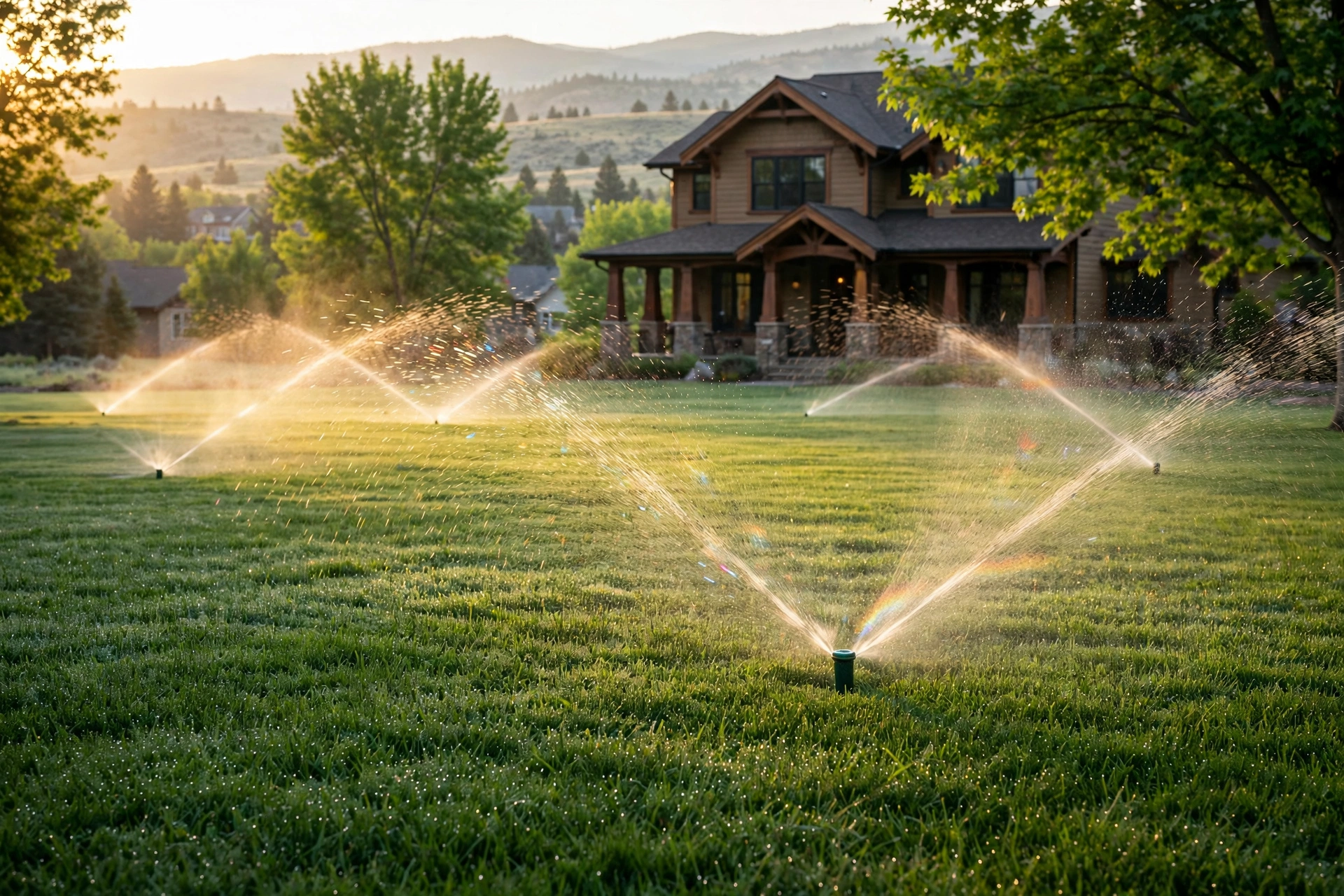
How often to water your lawn in Eagle has no single schedule that fits every lawn, but there is a simple way to find yours: know the weekly water target, measure what your sprinklers actually deliver, split it into sessions your soil can absorb, and adjust by season and what the lawn tells you.
For established cool-season lawns in Eagle, the University of Idaho Extension recommends about 1 inch of water per week from April to mid-May and about 2 inches per week (or slightly more) from late May through mid-August. That total is usually delivered in deeper, less frequent sessions — often two to three times a week in summer — rather than a light daily sprinkle. The rest of this guide shows how to turn those targets into actual minutes on your controller.
Seasonal watering guide for Eagle lawns
The table below uses University of Idaho Extension figures for cool-season lawns. The frequency patterns are general starting points, not a fixed schedule — your soil, sprinkler output, shade, and weather will move them.
| Season | Weekly water target | Typical frequency pattern | Notes |
|---|---|---|---|
| April to mid-May | About 1 inch (UI Extension) | Fewer sessions; check soil before starting | Cooler weather and spring rain help; irrigation systems may not be running yet |
| Late May to mid-August | About 2 inches, or slightly more (UI Extension) | Often 2 to 3 sessions per week on clay soils; more often on sandy soil | Hottest stretch; the highest demand of the year |
| Late August to October | Back toward about 1 inch (UI Extension: spring and fall) | Remove days as temperatures fall | Your irrigation district may shut water off before the lawn is “done” |
| Winter | No Idaho-specific schedule found | Minimal | Do not force a number; water only if the soil is dry and the ground is not frozen |
Kentucky bluegrass and perennial ryegrass may need up to 2 inches per week in peak summer heat and about 1 inch in the cooler spring and fall, according to UI Extension. Tall fescue uses about the same or more water overall, but its deeper roots often mean it does not need watering as frequently.
Why some sources say “1 inch” and others say “2 inches”
Both numbers are honest — they just describe different situations. National advice of about 1 inch per week often comes from cooler or rainier climates, while Idaho Extension’s higher peak-summer figure reflects Treasure Valley conditions: July and August bring average highs around 93°F and 91°F, only about 0.2 inch of rain per month, and roughly 12 inches of rain per year. A lawn that gets almost no rain in July simply needs more irrigation than one in a humid climate. Soil type, shade, wind, and how efficiently your sprinklers deliver water also move the number. That is why a single universal schedule cannot work — but the University of Idaho figures are the right starting point for this market.
How to turn inches per week into minutes and days
Minutes per zone = (weekly water target in inches ÷ sprinkler output in inches per hour) × 60, then divide the total minutes across your watering days.
Step 1: Set your weekly target. Use the seasonal table above — for example, about 2 inches in July.
Step 2: Measure your sprinkler output. Place straight-sided cans (tuna cans work) across a zone, run it for 15 minutes, and measure the water depth. Multiply by 4 to get inches per hour. Do this for each zone, because rotor and spray heads usually deliver at different rates.
Step 3: Do the math. If your cans show 0.75 inches per hour, then 1 inch per week needs about 80 minutes of runtime per week, and 2 inches per week needs about 160 minutes per week.
Step 4: Split it across days. Those 160 minutes fit into two or three sessions for clay soils. Note the soil limit below: putting it all in one session wastes water.
Illustrative example: a zone delivering 0.75 inches per hour with a 2-inch weekly summer target needs about 160 minutes per week. Split into three mornings, that is about 53 minutes per session. If your sprinklers deliver a different rate, your numbers will differ — always use your own measurements.
The best time of day to water
Water early in the morning. University of Idaho Extension points to three reasons: less wind, lower evaporation, and lower demand on municipal water systems at that hour. Early-morning watering also lets the grass blades dry during the day, which keeps foliage wet for a shorter time than evening watering. Evening is an acceptable fallback if mornings are not possible, but it leaves grass wet longer — and University of Idaho Extension notes that lawn disease in southern Idaho is generally linked to improper irrigation or fertility practices. Avoid the midday heat, when evaporation is highest.
What changes your schedule: soil, slope, sun, and grass type
Soil decides frequency, not the total amount. UI Extension explains that the grass uses the same weekly amount regardless of soil — soil only changes how that water is split into sessions.
| Soil type | How it behaves | What to do |
|---|---|---|
| Sandy | Drains fast, holds little | Water more often, less per session |
| Loam | Holds moisture well | Standard schedule; a good baseline |
| Clay | Holds water longer but absorbs slowly; about 1 to 1¼ inches may wet clay to a depth of 12 inches | Water less often, but split long sessions into two or three short runs (cycle-and-soak) so water infiltrates instead of running off |
Treasure Valley soils are often heavily compacted clay, which is why runoff down the driveway is such a common complaint. On slopes, split sessions are even more important.
Sun, shade, and wind: lawns with significant shade and wind protection need less water, though grass growing under trees competes with tree roots for water and nutrients, so watch those areas separately.
Grass type: Kentucky bluegrass has the highest summer demand; perennial ryegrass is similar. Tall fescue uses about the same or more water overall, but its deeper root system usually means fewer, deeper sessions work well.
Simple checks: does the lawn need water?
Footprint test: walk across the lawn. If your footprints stay visible because the blades do not spring back, the lawn is likely thirsty.
Screwdriver test: push a screwdriver into the soil. In moist soil it slides in easily to the depth you want water to reach; in dry soil it resists. UI Extension recommends this as the standard soil-moisture check.
Look at the color: water-stressed lawns turn gray to purplish-green, according to UI Extension. Do not wait for full browning.
Catch-can audit: the can test in the runtime section above is also the best way to find coverage problems — if one can is nearly empty, that zone has a dry spot no schedule change can fix.
Underwatering vs overwatering
| Symptom | Underwatering | Overwatering |
|---|---|---|
| Color | Gray to purplish-green (UI Extension) | Yellowing or patchy |
| Footprints and feel | Footprints stay visible; blades fold | Squishy, spongy ground underfoot |
| Soil check | Screwdriver will not penetrate dry soil | Soil stays wet or soggy hours after watering |
| Extra signs | Brown, crisp areas | Mushrooms, runoff, thatch, disease and weed pressure |
| Fix | Add depth or an extra session; check sprinkler coverage | Cut frequency, not just minutes; split runs; fix compaction or drainage |
Overwatering causes real harm: saturating the soil displaces air, encourages thatch and disease, and wastes water. More is not better — the right amount is.
Established lawns vs new grass seed
Established lawns do best with deep, less frequent watering that encourages roots to grow down. Newly seeded areas are the exception: seed needs the soil surface kept moist with light, frequent watering until germination. If you are seeding, see the site’s grass seed germination guide for the full new-seed schedule.
| Established lawn | Newly seeded area |
|---|---|
| Deep, less frequent sessions | Light, frequent sessions |
| Water to root depth (6–12 inches) | Keep only the surface moist |
| Goal: deep roots | Goal: germination |
Drought years and watering rules in Eagle
A few distinctions matter here. The Idaho Department of Water Resources issued a statewide emergency drought declaration on April 13, 2026 covering all 44 counties, but that declaration concerns temporary water-right changes — it does not by itself set a homeowner watering schedule. Actual watering rules come from your water provider: your utility, irrigation district, city, or HOA.
Eagle properties are served in different ways — pressurized irrigation systems, canal-delivered irrigation water, or potable water from a utility — and the provider affects your rules, your costs, and how long your irrigation season runs. Irrigation season generally runs about April through October, but shutoff dates vary by district, and there is no single verified Eagle schedule to cite.
If you want to check for restrictions, look at your own provider’s notices: your utility (for example, Veolia serves parts of Boise and Eagle), your irrigation district, the City of Eagle, or your HOA. During a drought year, the smart moves are the same regardless: fix sprinkler coverage first, water deeply, mow tall (the City of Boise recommends the tallest mower setting because longer grass shades the roots), and skip watering when rain has already done the job.
Common watering mistakes
Watering every day out of habit. A set-and-forget controller rarely matches the season. Review settings at least when summer starts and ends.
Chasing a neighbor’s schedule. Their soil, shade, sprinkler output, and water source are different from yours.
Ignoring runoff. If water runs down the driveway, that time is wasted — split the session.
Mistaking disease or insects for drought. Brown patches are not always thirst; if the screwdriver test shows moist soil, look at coverage, compaction, pests, or disease before adding water.
Evening-only watering. It can work, but it keeps foliage wet longer, which favors disease.
When to get professional help
Call in help when dry spots persist despite correct watering, water runs off no matter how you split sessions, coverage is visibly uneven, the controller confuses you, or the lawn will not recover. Before requesting an estimate, ask: what will the visit include (system check, coverage test, controller adjustment)? Which zones need repair and why? How will the schedule be adjusted by season? Are parts and labor itemized? And get a second quote if anything is unclear.
Lawn watering FAQs
Usually very little. There is no Idaho-specific winter schedule in the extension guidance. Water only if the soil is dry and the ground is not frozen — and never force a number.
Yes — rain counts toward the weekly total. A rain gauge is cheap and makes this easy to track.
Clay or compacted soil absorbs water slowly, and slopes shed it. Split long sessions into shorter runs with rest time between them (cycle-and-soak).
Early morning is best: less wind and evaporation, and the grass dries during the day. Evening is a fallback, not an equal choice.
New seed needs light, frequent watering to keep the surface moist until germination — the opposite of established-lawn watering. See the site’s germination guide for details.
No. Insects, compaction, poor coverage, and disease can look similar. Check soil moisture with the screwdriver test before adding water.
Find your number, then trust the lawn
Start with the University of Idaho seasonal targets, measure what your sprinklers deliver, split the total across days your soil can handle, and let the footprint and screwdriver tests tell you when to adjust. That loop — target, measure, split, check — is the whole system, and it works in any drought year and any neighborhood in Eagle.
If coverage problems or a confusing controller are getting in the way, a local lawn care professional in Eagle can evaluate your sprinkler system and watering schedule and give you a clear plan before you approve any work.