
EAGLE LAWN CARE · LAWN CARE GUIDE
Fall Lawn Care Checklist for Eagle, Idaho: Prepare Your Lawn for Winter
Fall lawn care checklist Idaho: aeration, overseeding, fall feeding, leaf care, and sprinkler winterization for Eagle lawns — in the right order.
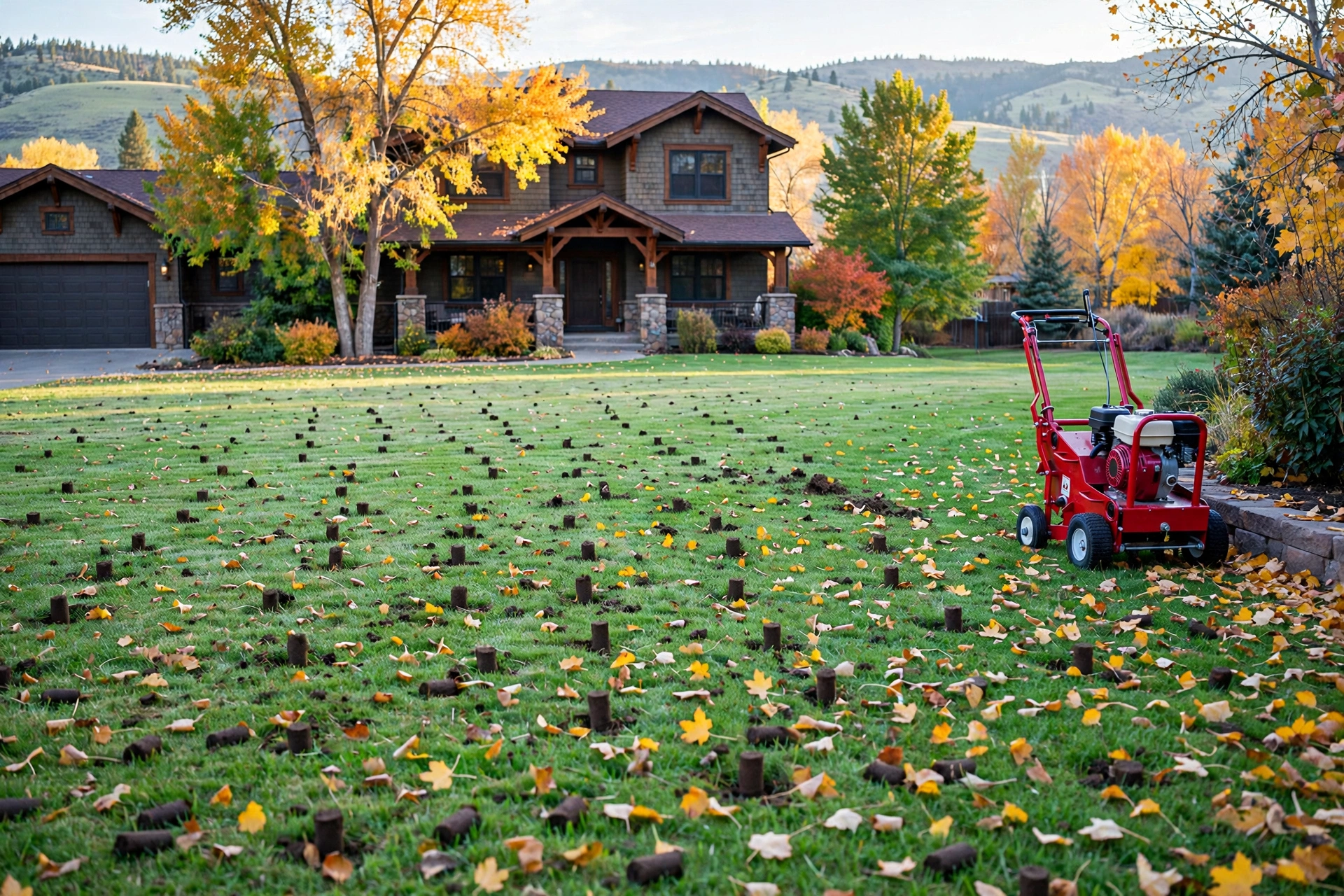
This fall lawn care checklist Idaho homeowners can rely on starts with one fact: fall is the most important season for cool-season lawns in Eagle. Feeding, aeration, and overseeding all peak now — this is when the lawn stores energy for winter and sets up next spring’s green-up. Start in late August or early September, and work in this order: assess summer damage, aerate, overseed, feed, control perennial weeds, manage leaves, adjust the final mows, apply the late fall feeding, taper watering, and winterize the sprinklers. One local fact drives the whole schedule: irrigation districts shut off water in early October — but shutoff is not winterization. More on that below.
When to Start: The Countdown
There is no single date for every Eagle lawn. Boise’s first 32°F frost has a median of October 18 (NWS 1991–2020), with a 30–70% band of October 7–21 and a first hard freeze (28°F) median of November 7 — and Eagle runs later and colder than the Boise valley floor. Use this countdown instead:
| Countdown | What to watch | Step it unlocks |
|---|---|---|
| ~8 weeks before first frost (late Aug/early Sept) | Soil still warm, lawn actively growing | Summer-damage assessment, aeration, overseeding |
| ~6 weeks out (early–mid Sept) | Daytime temps dropping below 85°F | First fall fertilizer application |
| ~4 weeks out (mid Sept–early Oct) | Perennial weeds actively growing | Post-emergent broadleaf weed control |
| District shutoff (early Oct; NMID 2026: water off Sept 28) | District notice | Final deep watering, then taper — start planning the blowout |
| ~2 weeks out (mid Oct) | Growth slowing, leaves falling | Late fall feeding (“winterizer” window) |
| First hard freeze (28°F; median Nov 7) | Forecast | Sprinklers must be blown out by now |
A single night at 28°F for several hours can freeze standing water in exposed pipe. Plan the blowout around the forecast, not a fixed date.
The Checklist, In Order
1. Assess summer damage — late August/early September. Walk the lawn before doing anything. Thin areas, bare spots, and compacted soil tell you whether aeration and overseeding are worth it this year. Brown patches can be summer dormancy breaking or drought stress, not necessarily dead turf — diagnose before renovating.
2. Aerate — early September. Fall is the best season for core aeration on cool-season lawns: recovery conditions are ideal, and it pairs with overseeding. It’s also the highest-value task for Treasure Valley clay soil. Aerate when soil is moist, aiming for 20–40 holes per square foot. Core aeration is the method; spike aerators compact instead of relieving compaction.
3. Overseed — right after aerating. Late summer/early fall is the best seeding window for cool-season grasses in Idaho, with optimum soil temperatures and less weed competition. Seed at least 45 days before the first expected frost. Use starter fertilizer at about 1 lb N/1,000 sq ft, and don’t fertilize the new seedlings for 4–6 weeks. Order callout: do not apply broadleaf weed control to newly seeded lawns — this is fall’s version of the spring pre-emergent conflict.
4. First fall fertilizer — early to mid September. University of Idaho Extension’s schedule calls for ~1 lb of nitrogen per 1,000 sq ft in the mid-August to September slot. Never more than 1 lb N per application.
5. Weed control — mid September to October. Fall is the best time for perennial broadleaf weeds (dandelions, clover, plantain): the herbicide translocates to the roots along with the plant’s carbohydrates as it stores energy for winter. Keep leaves off the turf first — leaf layers block herbicide contact.
6. Manage leaves — all fall. See the mulch-vs-remove section below.
7. Adjust the final mows. Keep mowing until growth stops — Kentucky bluegrass stops when daytime highs stay consistently below 50°F. For the final cut, sources disagree: University of Minnesota says keep the normal 2.5–3″ height and never scalp; Iowa State and several local contractors step down to 2.5–3″ or even 2–2.5″. The safe line everyone agrees on: lower gradually over several mows, and never scalp — cutting too short stresses the grass more than snow mold or voles would.
8. Late fall feeding — early to mid October. UI Extension’s second fall application is 1–2 lb N/1,000 sq ft in the early October/November window; slow-release for the late application. This is the “winterizer” feeding — see the honesty section below.
9. Taper watering. Cut back as temperatures drop. Stop routine irrigation when daytime highs stay below 50°F and nights are in the 30s–40s, and never irrigate frozen ground. Your district will force the issue anyway — water disappears in early October regardless of the lawn.
10. Winterize the sprinklers — before the first hard freeze. See the Eagle irrigation section below.
Summer Damage: What You’re Looking At
| Symptom | Likely cause | Action |
|---|---|---|
| Thin areas after summer heat | Heat/drought stress, foot traffic | Aerate + overseed in early September |
| Hard, compacted soil (screwdriver won’t penetrate) | Clay compaction, foot traffic | Core aeration while soil is moist |
| Spongy layer over 1/2″ between grass and soil | Thatch buildup | Core aeration is UI Extension’s preferred thatch method |
| Brown patches that don’t green up after watering | Possible dead turf or disease | Assess before renovating; consider a pro diagnosis |
| Weeds filled in where grass thinned | Crabgrass, broadleaf weeds | Fall post-emergent for perennials; plan pre-emergent for spring |
Leaves: Mulch or Remove?
Mulch-mowing is the research-backed answer for most situations. Michigan State research found mulched leaves lead to faster spring green-up, fewer weeds (~100% dandelion/crabgrass decrease after about 3 years), and no harm to thatch, pH, or disease — with layers up to 6″ handled fine. University of Minnesota’s cutoff: mulch while about half the grass is still visible.
- Mulch when: leaves are falling steadily and grass still shows through. Mow weekly with a mulching blade.
- Remove when: the layer is too thick to mulch (grass fully buried) or leaves are matted and smothering. A blanket of leaves blocks light and favors snow mold.
“Winterizer” — What It Actually Is
“Winterizer” is primarily a product description, not a special fertilizer category. What matters is a timed nitrogen application near the final mow, feeding roots while grass still grows underground — this is what stores energy for winter and drives early spring green-up. The common marketing claim to watch for: high-potassium “winterizer” formulas. Purdue turf specialists say extra potassium is unnecessary unless a soil test shows need. A timed nitrogen application at UI Extension’s rate is the honest version.
Irrigation: Shutoff Is Not Winterization
This is the most expensive local misunderstanding in fall lawn care. When the district shuts off water in early October, delivery stops — but residual water stays trapped in your private laterals, valves, heads, and backflow assembly. The first hard freeze cracks them.
Eagle has three water realities, and winterization steps depend on yours: pressurized irrigation (most post-late-90s subdivisions; city code requires it), canal-delivered via ditch companies like Settlers or Thurman Mill (your own pump and filtration), and potable-only in some foothills developments. Potable homes have no district shutoff at all — you’re on city water year-round and must winterize on your own schedule.
The blowout protocol: use compressed air to clear each zone before the first hard freeze (28°F), at no more than 50 psi for PVC or 80 psi for poly pipe, and never force air through a backflow device or pump. A winterization isn’t finished until every zone is blown, the backflow assembly is drained with test cocks and shutoffs left at 45°, and the controller is set to rain/standby mode. Backflow assemblies in Eagle also require annual testing by Idaho regulation, with a City of Eagle deadline of June 16 — a failed assembly found at spring startup traces back to a missed fall blowout.
What Fall Work Costs and Why Quotes Differ
No Idaho-specific pricing was found, so treat national ranges as budgeting guides, not local quotes. Two Eagle contractor blowout quotes exist ($80 flat for 5 zones + $7/zone; $115–$140 for a 5-zone system), but these are contractor marketing, not verified market data. Quotes vary with lawn size, what’s included, and the provider:
| Service | National range |
|---|---|
| Sprinkler blowout/winterization | $50–$150 (avg ~$90–$100) |
| Fall cleanup / leaf removal | $100–$400 per visit |
| Core aeration (pro) | $75–$250 (avg ~$140–$150) |
| Overseeding | $300–$1,500 depending on area |
| Aeration + overseeding bundle | $160–$425 per 10,000 sq ft |
| Fertilizer application (pro) | $55–$115 per application |
| Fall lawn care package (pro) | $300–$900 for a quarter-acre |
| Soil test (UI lab) | ~$35 |
| Aerator rental (DIY) | $75–$100/day |
Bundling aeration, overseeding, and fertilization often lowers the per-service cost. Ask for an itemized estimate so you can see what’s included and what’s separate.
Common Fall Mistakes
- Skipping fall entirely. Fall is the most important season for cool-season lawns — not a wind-down.
- Assuming shutoff = winterized. The single most expensive fall mistake in the Treasure Valley.
- Fertilizing late or heavy. Excess nitrogen pushes tender growth into frost; follow UI Extension’s rates and the early-to-mid-October anchor.
- Scalping the final mow. Never cut below what the sources’ range allows; lower gradually or not at all.
- Leaving a blanket of leaves. Light scattering is harmless; smothering layers invite snow mold.
- Spraying weeds on new seed. No broadleaf herbicide on young seedlings.
- Aerating saturated soil. Wait for moist, not muddy.
DIY or Hire?
Doing it yourself covers leaf mulching, mowing adjustments, granular fertilizer, and visual sprinkler checks. Hire help for core aeration, overseeding large areas, and especially the compressed-air blowout — component pressure limits make blowouts a pro’s job for most homeowners.
Before requesting a fall estimate, ask: what’s included in the cleanup visit? Is aeration core or spike, and how many holes per square foot? Is seed included in overseeding, and is my lawn a good candidate this year? What’s included in the blowout quote — are backflow test or repairs separate? What’s the schedule if weather shifts? And get a second quote if anything is unclear.
Frequently Asked Questions
Late August to early September for assessment, aeration, and overseeding. Key off soil warmth, grass growth, the October 7–21 first-frost band, and your district’s shutoff date.
Fall is best — recovery conditions are ideal and it pairs with overseeding. Spring is a solid second choice.
Late summer to early fall, at least 45 days before the first expected frost. Fall beats spring decisively for seed establishment.
A late-fall nitrogen feeding near the final mow that stores energy in roots. The high-potassium marketing is disputed — timed nitrogen at the right rate is what matters.
Mulch-mow while about half the grass is still visible; remove surplus or matted layers. Research shows mulched leaves speed spring green-up and reduce weeds.
Blow out with compressed air before the first hard freeze (28°F) — in the Valley, roughly October to mid-November, keyed to your district’s shutoff and the forecast. Shutoff alone does not winterize the system.
Before You Start
Fall is the season that decides next spring. Assess and repair while soil is warm, feed on University of Idaho Extension’s two-application schedule, manage leaves as they fall, and get the irrigation system blown out before the first hard freeze — because the district shuts your water off in early October, and shutoff is not winterization. If the aeration, overseeding, or blowout is more than you want to handle, request an estimate from Eagle Lawn Care — get a clear, itemized plan before approving anything.