
Granular vs. Liquid Fertilizer: Which Is Better for Eagle, Idaho Lawns?
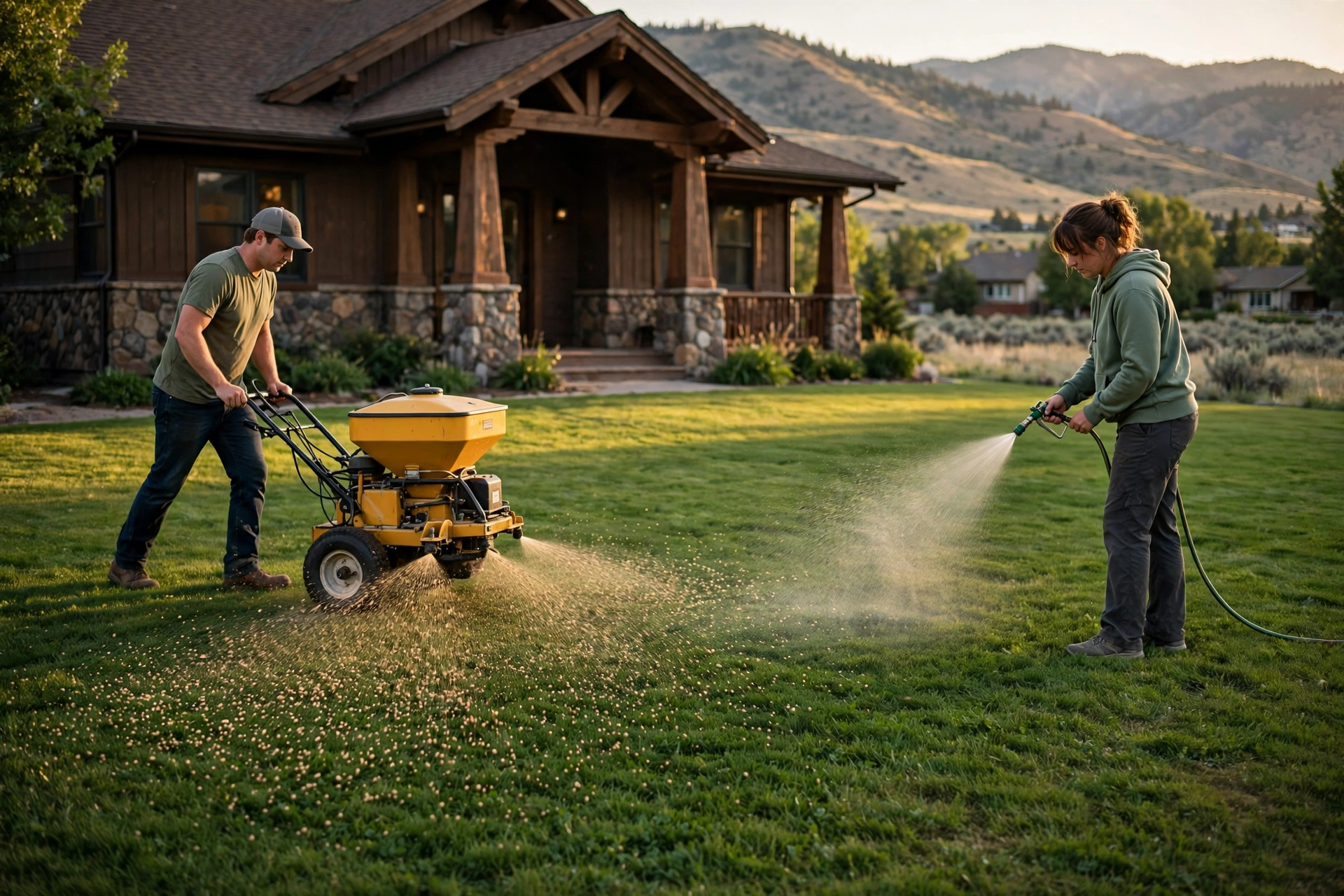
Neither fertilizer type is better across the board. Liquid fertilizer feeds your lawn fast but doesn’t last long, while granular fertilizer works more slowly but keeps feeding for weeks or months at a time. The right choice depends on what your lawn needs right now, how much upkeep you want to manage, and — in Eagle’s hot, dry summers and cold winters — how often you’re realistically willing to reapply.
This guide breaks down the real granular vs. liquid fertilizer differences, explains how each format interacts with the Treasure Valley’s climate and watering season, and helps you decide whether one format, or a combination of both, makes sense for your lawn.
The Core Difference: Speed vs. Duration
The granular vs. liquid fertilizer comparison starts with the same basic nutrients — nitrogen, phosphorus, and potassium — delivered in very different ways.
Liquid fertilizer is absorbed almost immediately. Because it’s already dissolved, your lawn’s roots and leaves can start using it right away, which is why liquid-fed lawns often green up noticeably faster. The tradeoff is that this effect doesn’t last. Most liquid applications are spent within a couple of weeks, so keeping a lawn consistently fed means reapplying roughly every two to three weeks.
Granular fertilizer works in the opposite direction. The pellets have to break down in the soil before the grass can use the nutrients inside them, so results show up more gradually — often over several days to a couple of weeks before you notice a difference. What you get in exchange is duration: depending on the formulation, a single granular application can keep feeding your lawn for several weeks, and some slow-release products stretch to a few months.
Here is the granular vs. liquid fertilizer comparison at a glance:
| Factor | Liquid Fertilizer | Granular Fertilizer |
|---|---|---|
| Nutrient availability | Fast — within days | Gradual — as granules break down |
| How long it lasts | Roughly 2–3 weeks | Several weeks, sometimes up to a few months |
| Application method | Hose-end or tank sprayer | Broadcast, drop, or hand-held spreader |
| Typical cost pattern | Higher over a season, due to frequent reapplication | Lower over a season, fewer applications needed |
| Burn risk | Overspray or concentrated spots, especially in hot weather | Higher salt content; uneven spreading or spills |
| Best fit | A quick green-up, new lawns, or targeted trouble spots | Long-term, lower-maintenance feeding for an established lawn |
Why This Matters More in Eagle’s Climate
Eagle sits in a high-desert climate — hot, dry summers and cold winters — and that pattern changes how practical each fertilizer format actually is, not just how it works on paper.
Granular’s longer feeding window is a real advantage here. Because it keeps releasing nutrients over weeks rather than days, you’re not stuck reapplying fertilizer in the middle of a hot, dry stretch when your lawn is already under stress. Liquid’s shorter duration means more frequent applications, and some of those applications are more likely to land during the exact weather conditions — extended heat, low humidity — where fertilizing (in either format) is riskiest for the lawn.
That doesn’t make liquid the wrong choice. A fast-acting liquid application still has a real role for a quick green-up in spring, or for spot-treating a patchy or slow-to-recover area. It just means liquid works best as an occasional tool here, not necessarily your full-season feeding plan.
Granular’s higher salt content is also worth factoring in for a dry climate specifically. Salt-based burn risk is reduced significantly by watering in the fertilizer after application, and in a climate where soil dries out quickly, that watering-in step matters more than it would somewhere with regular natural rainfall.
The Irrigation Connection
Treasure Valley’s irrigation-district watering season generally runs from around mid-April through early October — which lines up closely with the months most homeowners are actively fertilizing. That overlap is genuinely useful: watering in fertilizer, whether granular or liquid, helps move nutrients to the root zone and reduces burn risk, and it’s easiest to do consistently while your sprinklers are already running on a regular cycle.
Outside that window — in late fall or winter, if you’re applying a final-season granular feeding — you’re relying on manual watering or natural moisture instead, which is worth planning for rather than assuming your irrigation system will handle it.
Does Grass Type Change the Answer?
Not fundamentally. Kentucky bluegrass and tall fescue — the two most common cool-season grasses in the Eagle and Treasure Valley area — both respond to granular and liquid fertilizer the same basic way. Neither grass type requires one format over the other.
What does matter more than format is timing and rate, which depends on your specific product’s label and the season. If you want a deeper breakdown of nitrogen ratios and seasonal timing for these grass types, that’s covered in more detail on our lawn fertilization service page and in our guide to seasonal fertilizer timing in Ada County — this article focuses specifically on choosing between granular and liquid, not on building a full seasonal program.
Fertilizer Burn: What Actually Causes It in Each Format
Fertilizer burn shows up as yellow or brown streaks and patches, and homeowners sometimes assume it only happens with one type. In reality, both formats can cause it, just through different mechanisms.
Granular burn usually comes from the fertilizer’s salt content pulling moisture away from grass roots and blades, especially when granules are applied too heavily in one area, spilled, or not watered in promptly. Uneven spreader coverage — overlapping passes or a miscalibrated spreader — is a common, avoidable cause.
Liquid burn typically comes from overspray or applying too much product to one spot, particularly during hot weather when the lawn is already under stress. Because liquid is absorbed quickly, a concentrated application has less time to disperse before it affects the grass.
Reducing the risk, either way:
- Follow the product label’s rate exactly — more isn’t better
- Water in granular fertilizer within a day or two of application
- Avoid applying either type during extended heat stress or on a drought-stressed lawn
- Calibrate a spreader before using it, and overlap passes evenly rather than guessing
- With a sprayer, move at a steady pace and avoid double-covering the same area
Can You Combine Granular and Liquid Fertilizer?
Yes, and it’s a reasonably common approach rather than just a sales pitch to buy more product. A typical combination strategy uses granular fertilizer as the base, long-term feeding for your lawn throughout the season, with an occasional liquid application layered in when you want a faster response — for example, after a stressful stretch of weather, at the start of spring green-up, or to perk up a specific patchy area.
In the granular vs. liquid fertilizer debate, the two aren’t competing against each other so much as serving different jobs: granular for steady, lower-maintenance feeding, and liquid for quick, targeted results when timing matters more than longevity.
Weighing the Cost Over a Season
Exact dollar-for-dollar granular vs. liquid fertilizer pricing isn’t something reliable data supports making a firm claim about — costs vary by product, brand, and lawn size. But the general pattern holds up consistently: granular tends to cost less over a full season because you’re buying and applying it less often, while liquid’s higher per-application cost adds up faster given how frequently it needs reapplying.
For context, professional lawn fertilization programs in Idaho are commonly priced in the range of roughly $75–178 per application for an average residential lawn, with full annual programs often falling somewhere between $150–355 depending on lawn size and the number of applications. These are regional figures, not an Eagle-specific quote, and your actual cost will depend on your lawn’s size, condition, and the specific program you choose.
DIY or Professional: What Each Format Actually Requires
Choosing a fertilizer format isn’t just a product decision — it also means taking on the equipment and judgment that comes with applying it correctly.
Granular fertilizer requires a spreader, and getting even coverage means calibrating it to your product’s rate and walking a consistent pattern across your lawn — skipping this step is one of the more common reasons for streaky or patchy results. Liquid fertilizer is generally easier to apply with a hose-end sprayer, but getting even coverage without overlapping (and risking burn) still takes some attention, especially on a larger lawn.
Both formats also require matching the product to the season, reading the label correctly, and adjusting for weather — none of which is complicated, but all of which takes some ongoing attention through the year. If tracking that isn’t something you want to manage yourself, a local lawn care provider can handle the format, rate, and timing decisions as part of an ongoing program, rather than leaving you to make a new call every few weeks.
FAQ
In the granular vs. liquid fertilizer choice, neither is universally better — it depends on the situation. Granular suits long-term, lower-maintenance feeding for an established lawn, while liquid is better suited to a fast green-up or targeting a specific problem area.
Liquid is typically absorbed within days, producing visible results faster. Granular takes longer to show results — often a week or two — because the granules need to break down first, but it keeps feeding the lawn for much longer afterward.
It varies by formulation, but many granular products keep feeding a lawn for several weeks, and some slow-release versions last up to a few months.
Both carry a real burn risk if misapplied. Granular’s risk usually comes from its salt content and uneven spreading; liquid’s risk usually comes from overspray or concentrated application, especially in hot weather. Following the label rate and watering in properly reduces the risk for either type.
Yes. A common approach is using granular as your base, ongoing feeding and liquid as an occasional supplement for a faster response when needed.
It doesn’t rule either one out, but it does make granular’s longer feeding window more practical during peak heat, since it means fewer applications during stretches when fertilizing is riskiest. Liquid still has a place for quick, targeted applications outside of extreme heat.
Choosing What’s Right for Your Lawn
If your lawn is healthy and established and you’d rather not think about fertilizer every few weeks, the granular vs. liquid fertilizer choice usually leans granular — it’s the more practical long-term option, especially through Eagle’s hot summer stretch. If you’re dealing with a slow-to-green lawn, a new lawn getting established, or a specific patch that needs attention now, liquid’s faster response is worth the extra reapplication effort. And if you want the benefits of both, using granular as your season-long base with liquid as an occasional boost is a reasonable, non-gimmicky approach.
If weighing formulations, rates, and timing against your lawn’s actual condition isn’t something you want to manage yourself, a local lawn care provider can take that decision-making off your plate and keep your lawn fed on the right schedule throughout the year.