
EAGLE LAWN CARE · WEED CONTROL GUIDE
Pre-Emergent vs. Post-Emergent Weed Control: Which Is Best for Lawns in Eagle, Idaho?
Use this guide to understand pre-emergent vs post-emergent weed control and choose the right approach for each weed in your Eagle lawn.
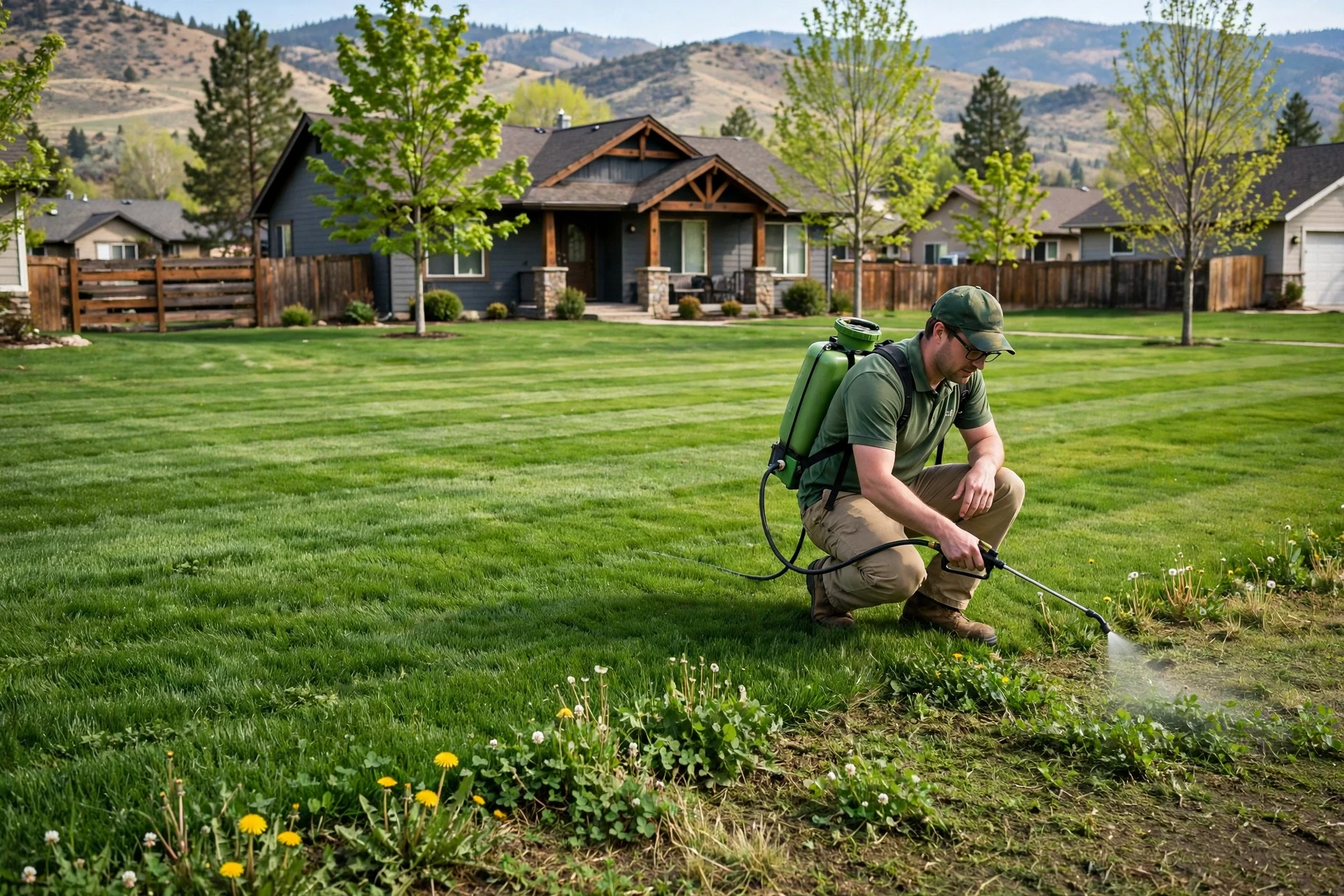
Neither is always better. Pre-emergent weed control is applied before certain weeds establish, so it works mainly on weeds that start from seed each year. Post-emergent weed control targets weeds that are already growing. The right choice depends on the weed, the time of year, your grass type and the product label.
This guide starts with the weeds in your lawn instead of the products. It covers when each approach makes sense in the Treasure Valley, how irrigation and heat affect results, what to know before overseeding, and when it’s worth bringing in a professional.
The Quick Comparison
| Question | Pre-emergent | Post-emergent |
|---|---|---|
| What it does | Stops germinating weed seedlings before they establish | Controls weeds that are already growing |
| Typical targets | Mostly annual weeds from seed, such as crabgrass (label-specific) | Existing weeds, including perennials like dandelion and clover (label-specific) |
| What it won’t do | Kill established plants or control overwintered perennials | Stop future seeds from sprouting, unless the label says it has residual activity |
| Timing signal | Soil temperature and the label, before germination | Weeds actively growing, plus temperature, wind and rain limits |
| Effect on grass seed | Can block desirable seed too | Seeding and new-lawn restrictions per label |
| Watering | Often needs to be watered in, per label | Often needs a dry period afterward, per label |
Treat the table as a starting point. Whether a product works on a specific weed depends on its active ingredient, the weed’s growth stage and the application timing. Many weeds aren’t controlled by either type, so always confirm the target weed is on the label — that is the heart of pre-emergent vs post-emergent weed control.
Start With the Weed: Which Tool Fits?
Most advice treats “weeds” as one problem. They aren’t. University of Idaho Extension sorts weeds by life cycle, and that explains why the same product can work on one weed and do nothing to another.
| Weed type | Examples | Does pre-emergent help? | Does post-emergent help? |
|---|---|---|---|
| Summer annual grasses | Crabgrass, green foxtail | Yes, if applied before germination | Yes, with a selective product while plants are young |
| Summer annual broadleaves | Spotted and prostrate spurge, prostrate knotweed | Label-specific | Yes, with a broadleaf product while young |
| Perennial broadleaves | Dandelion, white clover, plantain | Generally not for established plants | Yes, most effective in fall |
| Winter annuals | Downy brome, shepherd’s purse | Not established as standard Idaho practice | Pull, hoe or spot-treat while young |
| Perennial grasses | Quackgrass, tall fescue growing as a weed | Neither is a simple fix | Needs correct identification first |
Nebraska Extension notes that pre-emergent products generally won’t control overwintered perennials like dandelion, clover, ground ivy and wild violet. This is why a homeowner who put down a “preventer” in spring can still see dandelions. The product was never aimed at those plants.
How Pre-Emergent Weed Control Works
Pre-emergent herbicides act on seedlings as they germinate. They don’t kill mature plants. The seeds are already in the soil, so the goal is to have the product in place before they sprout.
Timing: soil temperature, not a date
For crabgrass, the common trigger is soil temperature. Nebraska Extension uses 55°F at a 4-inch depth for several days, and University of Idaho Extension (Power County) describes germination starting around 55 to 60°F. Soil warms more slowly than air, so one warm afternoon doesn’t mean the window has opened.
No Eagle-specific germination study turned up, so avoid any page that offers one fixed date for every Treasure Valley lawn. Watch the multi-day warming trend, use a soil thermometer if you want a real reading, and follow the label.
Residual and watering-in
Pre-emergent products begin breaking down as soon as they’re applied. Applying too early can shorten the protection you get during peak weed growth. Some labels also call for a second application later in the season. Many pre-emergents need irrigation or rain to activate them, but amounts and timing are specific to each product.
How Post-Emergent Weed Control Works
Post-emergent herbicides are absorbed by weeds that are already up. Selective products target certain weeds without harming the lawn. Nonselective products, such as glyphosate, can kill nearly any plant they touch, including your grass.
Timing: young weeds and fall for perennials
University of Idaho Extension says annual weeds are controlled best at the seedling stage, because control gets harder once they flower. Perennials are a different story. It reports that spring applications and hot, dry conditions around 85°F work poorly on them, and that fall spraying from about August 15 to October 15 is most effective. That’s especially true after the first light freeze, when plants move nutrients, and absorbed herbicide, down to the roots.
The window isn’t unlimited. The Power County Extension fall guidance says treatment becomes less effective once a hard frost damages the leaves.
Conditions that make or break a spray
University of Idaho’s lawn guidance gives specific conditions:
- Spray when weeds are actively growing, temperatures are 50 to 80°F, winds are under 10 mph and no rain is forecast.
- Don’t apply 2,4-D-type products if the day is forecast to top 80°F, because high heat can cause them to volatilize and injure nearby plants.
- Don’t spray drought-stressed weeds. They absorb less.
- Spot-treat scattered weeds instead of treating the whole lawn.
The same publication notes that granular herbicides are generally not as effective as liquid products. It also says certain grass-weed herbicides can temporarily discolor turf, so the soil should be moist beforehand.
How Eagle’s Climate Changes the Advice
Eagle’s hot, dry summers and mostly irrigated lawns matter in a few specific ways. Mentioning them is only useful where they change what you do.
Irrigation can stress turf. Over- or under-watering stresses cool-season grasses, and stressed or thin turf invites weeds. University of Idaho suggests watering two to three times per week, enough to soak 6 to 8 inches deep in silt loam or clay soils. Sandy soils need more frequent, shallower watering.
Watering-in and irrigation breaks interact with labels. Some products need water to activate, and others need a dry window. Read the label’s irrigation and rain directions before you set the sprinkler schedule.
Summer heat narrows spray windows. Many hot July and August days fall outside the 50 to 80°F range, which is another reason fall is the main window for perennial weeds.
Frost limits the fall window. The Treasure Valley’s first frost typically arrives in early to mid-October, so it’s wise to plan earlier in the season than you think.
Check current water-use rules for your supply before changing your watering routine, since restrictions can apply to some customers.
Pre-Emergent Products and Grass Seed
Pre-emergents can’t tell weed seed from grass seed, so they can block the seed you want to grow. Wait times after application vary widely between products and between sources, anywhere from several weeks to several months, so rely on your label instead of a rule of thumb.
Some products are labeled for use at seeding. Extension sources name siduron and mesotrione as examples. Whether a product is right for your lawn depends on its current label. That’s why the plan matters if you intend to overseed. Many homeowners prevent in spring and repair in fall, which keeps the two jobs from colliding.
Kentucky Bluegrass and Tall Fescue
University of Idaho Extension says most Idaho home lawns are Kentucky bluegrass, perennial ryegrass, tall fescue, fine fescue or a blend. For weed control, that creates two practical points.
Species matters. A product labeled for Kentucky bluegrass may not be labeled for fine fescue or for a new lawn. In a blend, the most sensitive grass sets the limit.
Tall fescue can be a weed. In a bluegrass lawn, a coarse, clumping patch of tall fescue is a weed, and crabgrass products aren’t a simple fix for it. Correct identification comes first, and University of Idaho Extension can help confirm what you have.
When to Combine Both: Four Illustrative Scenarios
These examples are hypothetical and only illustrate how the logic works.
Dandelions in early fall. Pre-emergent won’t help plants that are already established. A post-emergent applied while leaves are green and before a hard frost fits the timing best, spot-treating if the weeds are scattered.
Crabgrassalong the driveway every summer, nothing visible yet in spring. This points to a pre-emergent planned around soil temperature, with attention to the label’s watering directions and any seeding plans.
A thin lawn the owner wants to overseed. The spring pre-emergent decision collides with seeding. Options include skipping the preventer in that area, seeding in fall, or asking about a product labeled for use at seeding.
A newly seeded lot. Both product types carry restrictions on new seedings. Identify the weed first, and check wait times before treating anything.
A thick, healthy lawn supports every one of these. University of Idaho recommends proper irrigation, mowing (never removing more than a third of the blade at once), fertilizing and annual aeration, because weeds readily invade stressed lawns and bare or disturbed soil.
Common Weed Control Mistakes
With pre-emergents
- Expecting them to kill weeds that are already up.
- Applying too early, which shortens protection, or after germination has begun.
- Skipping the watering-in step when the label calls for it.
- Disturbing treated soil by raking or aerating soon after application.
- Overseeding without checking the reseeding interval.
With post-emergents
- Spraying in heat, wind or just before rain.
- Treating drought-stressed weeds.
- Using a product that isn’t labeled for turfgrass, your grass species or the target weed.
- Spraying the whole lawn when a few spots need treatment.
- Applying nonselective products in the lawn.
With expectations
- Looking for a weed-free lawn in one season. Control builds over time, and no product handles every weed.
Combination “weed and feed” products deserve a careful read. Fertilizer-plus-herbicide products may have timing requirements that conflict with the weeds you’re trying to treat.
When Hiring a Professional Makes Sense
Many homeowners manage weeds themselves. Professional help tends to fit when:
- You aren’t sure which weeds you have.
- Timing is the hard part, such as catching the pre-emergent window and the fall perennial window.
- You have a blend of grasses or a new seeding, where product choice is tricky.
- You’d like follow-up instead of repeat trips to the store.
What to ask before requesting an estimate
Are you licensed? Idaho Code §22-3404 requires a professional applicator’s license from the Idaho State Department of Agriculture to apply pesticides for hire, with narrow exemptions. ISDA’s lookup tool can confirm a license.
How do you decide timing? Look for answers based on soil temperature and weed stage, not a fixed date.
Do you follow label directions for rates, watering and reseeding intervals?
How do you handle overseeding or new-lawn plans?
What happens if weeds return? Ask about follow-up.
What are the precautions for kids and pets? Ask for product-specific label language, not a general reassurance.
If you’d like help planning the right mix of prevention and treatment, you can request an estimate from Eagle Lawn Care. The company’s weed control service includes pre-emergent applications timed to stop crabgrass before it germinates.
Frequently Asked Questions
Sometimes, but the label decides for any pre-emergent vs post-emergent weed control combination. The two products solve different problems, and each has its own timing, watering and seeding rules, so check that the combination is allowed.
Generally not once they’re established. Pre-emergents act on germinating seedlings and typically don’t control overwintered perennials like dandelion and clover.
For weeds already growing, yes. A pre-emergent won’t kill them. Treat the visible weeds with a labeled post-emergent or by pulling, and plan prevention for next season.
University of Idaho advises against applying 2,4-D-type products when the day’s forecast exceeds 80°F and suggests spraying at 50 to 80°F. Always follow your product’s label.
Safety depends on the product. Follow the label’s instructions and re-entry directions, and ask a provider for product-specific label language.
Evidence is limited. Healthy turf, correct mowing and watering, and hand-pulling do help. Treat any “natural” product as one tool, and check what its label claims it controls.
The Takeaway
Pre-emergent weed control prevents certain seed-grown weeds. Post-emergent weed control treats weeds that are already growing. Most lawns benefit from understanding both, because the weed in front of you, the time of year and your grass decide which one applies. Spring prevention fits summer annuals like crabgrass. Fall treatment fits perennials like dandelions. A dense, well-watered lawn improves both.
If you’d rather not track soil temperature and spray windows yourself, you can request a lawn care estimate from Eagle Lawn Care and ask how they would time prevention and treatment for your yard.