
How to Get Rid of Crabgrass in Idaho: Prevention, Treatment, and Lawn Care Tips for Eagle Homeowners
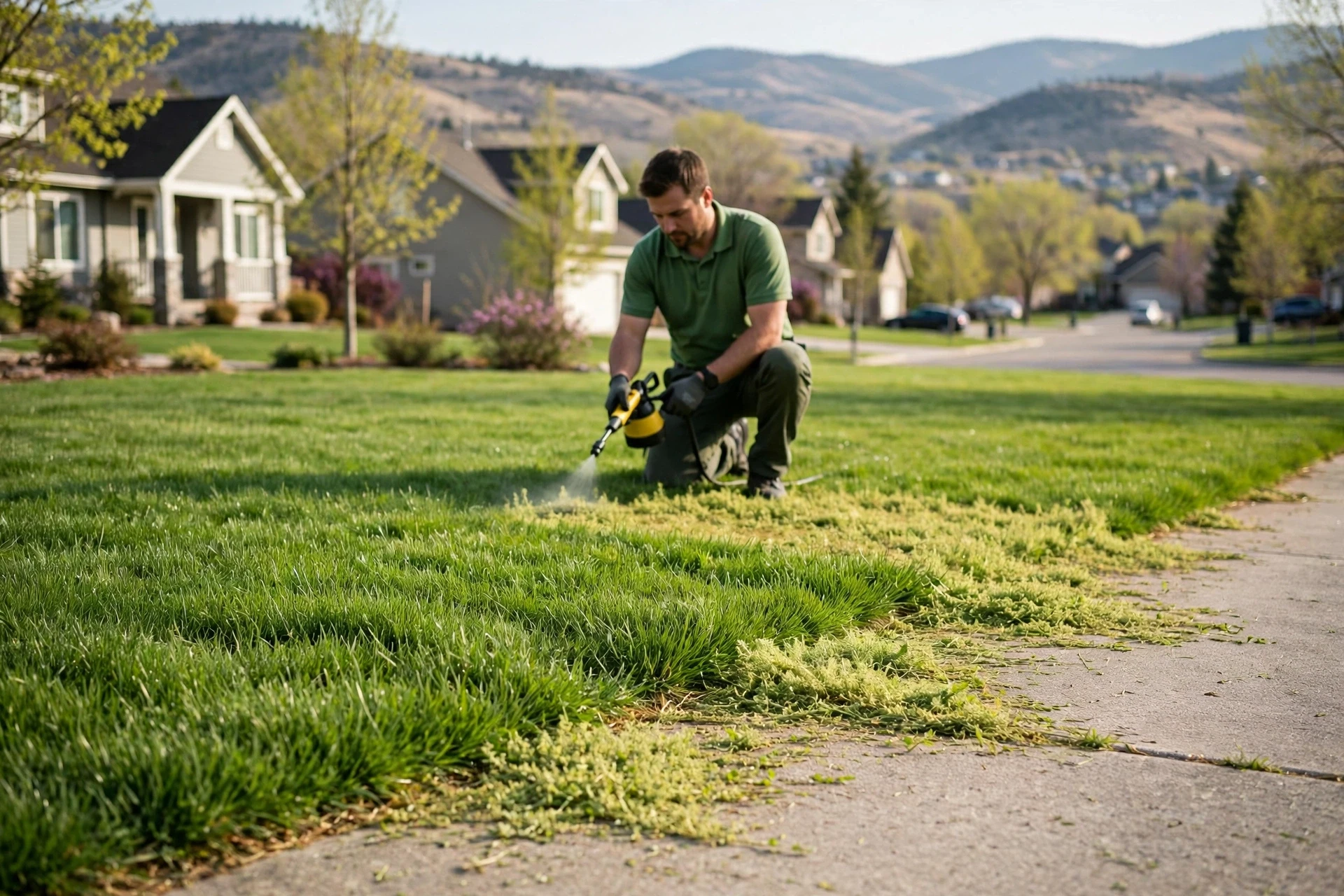
The most effective way to get rid of crabgrass in Idaho is to stop it before it germinates, because a pre-emergent herbicide prevents seedlings but generally won’t kill plants that are already growing. If crabgrass is already in your lawn, you can still pull small patches or use a selective post-emergent product while the plants are young. Either way, expect it to take more than one season. There’s no permanent fix, because each plant leaves seed behind.
This guide to how to get rid of crabgrass in Idaho helps you find where your lawn stands today and what to do next. It covers how to confirm it’s crabgrass, when to treat, which products suit your grass type, and when hiring help makes sense.
Quick Answer: What to Do Based on Where You Are Right Now
| Your situation | What to do |
|---|---|
| Nothing visible yet (late winter to spring) | Time a pre-emergent to soil temperature, not the calendar |
| Tiny seedlings just showing | Narrow window; some products work on very young plants, but a standard preventer won’t |
| Established plants with side shoots, not yet seeding | Pull small patches or use a selective post-emergent labeled for your grass |
| Seedheads forming (mid to late summer) | Focus on stopping seed spread; don’t expect a full rescue |
| After the first hard frost | Repair the lawn: aerate, overseed, fix irrigation, soil test |
The rest of this article explains each stage.
What Crabgrass Is, and Why It Shows Up Where It Does
Large crabgrass is a warm-season annual grass. It germinates from seed in spring, grows through summer, and dies after a hard frost, but the seeds it drops stay in the soil. University of Idaho Extension (Power County) notes that one plant can produce thousands of seeds, and that it can set seed even when mowed as low as half an inch.
That seed bank explains why crabgrass seems to appear from nowhere each year. It’s also why “it died in the fall” doesn’t mean you’re done.
Where crabgrass tends to start
University of Idaho Extension describes crabgrass as often established in thin or stressed areas, especially along sidewalks and driveways where the soil gets warm and dry. In an irrigated high-desert yard around Eagle, that usually points to one of these:
- Edges beside concrete and asphalt that bake in July heat
- Thin turf or bare spots left from pets, foot traffic, or past weed damage
- Spots missed by sprinklers, whether from a broken or misaligned head or a poor spray pattern
- Compacted soil, which stresses turf and thins it out. Newer lots can have compacted subsoil under thin topsoil, which can give crabgrass an opening.
Crabgrass also tolerates shade poorly, so it mostly turns up in full-sun areas.
Is It Really Crabgrass? Common Look-Alikes
Misidentification is a common reason treatments fail. Crabgrass has hairy leaves and sheaths, a sprawling habit, stems that can root where they touch soil, and finger-like seedheads. Several other grasses get mistaken for it:
| Plant | Key identifiers | Why it’s confused with crabgrass | Does crabgrass control apply? |
|---|---|---|---|
| Tall fescue | Upright, clumping, perennial, green year-round | Coarse blades look out of place in bluegrass lawns | No. It’s a perennial, and crabgrass products can harm it |
| Quackgrass | Spreads by rhizomes; clasping auricles at the leaf base; single-spike seedhead | Coarse, light-green patches | No. It’s a perennial with a different control approach |
| Foxtail, goosegrass, barnyardgrass | Other summer annual grasses | Similar summer timing and coarse texture | Varies; confirm identity first |
Crabgrass is an annual, so it dies each fall and returns from seed. A coarse grass that stays green in the same spot year after year is probably a perennial. If you’re unsure, University of Idaho Extension offices serve both Ada and Canyon counties and can help confirm what you have before you spend money on a product.
When to Apply Crabgrass Preventer in Idaho
Time preventer by soil temperature, not by date.
University of Idaho Extension (Power County) says crabgrass germination begins when soil reaches roughly 55 to 60°F. Other extension sources suggest applying preventers when soil is around 50 to 55°F so the product is down before germination starts. The numbers differ because germination onset and peak germination aren’t the same thing. The practical takeaway is to get the product down while soil is still just below that range and warming.
Why not just pick a date?
Calendar dates mislead because spring varies from year to year. Southern Idaho can have a warm week in March followed by a cold snap. The Power County Extension article, from eastern Idaho, describes germination as normally occurring around March and mid-April in that area. Eastern Idaho is colder than the Treasure Valley, so Eagle lawns may warm earlier, but no Eagle-specific germination study turned up, so treat any single “Eagle crabgrass date” you see online with caution. Some local pages publish fixed windows without supporting data.
How to read the warming trend
- Watch soil, not air. Soil warms more slowly than air, so one 70°F afternoon doesn’t mean germination has started.
- Look for a multi-day trend. Several consecutive warm days matter more than a single spike.
- Account for microclimates. South-facing slopes, bare soil beside pavement, and sunny edges warm faster than shaded or moist areas, so crabgrass can start in different parts of the same yard at different times.
- Measure it. A basic soil thermometer gives you an actual reading instead of a guess.
Whatever product you use, follow the label for application rate and for whether it needs to be watered in. Prodiamine, one of the active ingredients named in the Extension article, must go down before germination and be watered in per label directions.
Can You Kill Crabgrass Once It’s Growing?
Yes, but with limits. A pre-emergent herbicide works near the soil surface to stop seedlings from establishing, and it generally won’t kill crabgrass that’s already up. Treating established plants is a different job that needs different tools.
Pre-emergent vs. post-emergent: the options compared
| Method | What it does | Best timing | Limits to know |
|---|---|---|---|
| Pre-emergent herbicide | Stops crabgrass seed from establishing | Before germination, based on soil temperature | Doesn’t kill established plants; can block desirable grass seed; follow the label for watering and reseeding |
| Early post-emergent activity (dithiopyr, per the Extension article) | Can control very young crabgrass shortly after it starts | While plants are very young (Rutgers describes roughly the 1 to 4 leaf stage) | Less effective once plants form side shoots (tillers) |
| Selective post-emergent (quinclorac or fenoxaprop, named in extension sources) | Kills existing crabgrass without killing certain lawn grasses | Small, actively growing plants | Grass-type tolerance and label limits; may be restricted on new seedings |
| Hand-pulling | Removes individual plants | Early, before seed set, when soil is moist | Practical only for small patches; remove the whole plant, including rooted nodes |
| Lawn-density practices | Reduce bare soil and the weed’s advantage | Year-round, especially fall repair | Slow; not a rescue for a heavy infestation |
| Nonselective products | Kill any grass they touch | Not for lawns | Will damage the grass you want to keep |
“Crabgrass killer” and “crabgrass preventer” are not the same product. Check the label before you buy.
If you only have a small patch
- Pull while the soil is moist so the roots come out.
- Get the whole plant, including any stems rooted at the nodes.
- Remove it before seedheads form, and don’t leave pulled plants lying on the lawn.
- Fill the gap with healthy turf so the spot doesn’t reopen.
If the crabgrass is already seeding
By mid to late summer, the realistic goal is to keep it from dropping more seed. University of Idaho Extension notes that preventing seed production for about three years can substantially reduce the seed bank. Then plan your fall repair and next spring’s timing.
Choosing a Product That’s Safe for Your Grass Type
Fear of hurting the good grass is one of the biggest worries homeowners have, and it’s legitimate. Different products tolerate different grasses, so identify yours first. The examples below come from extension sources outside Idaho, and the current product label always governs.
| Grass type | Notes from extension sources | Caution points | What to check on the label |
|---|---|---|---|
| Kentucky bluegrass | Quinclorac is labeled for established stands | Fenoxaprop can stunt or injure some Kentucky bluegrass, especially in high heat | Listed grass species, temperature limits |
| Tall fescue | Quinclorac is labeled for established stands; fenoxaprop is relatively safe on most cool-season grasses | Newly seeded stands have their own timing rules | Time since seeding |
| Perennial ryegrass | Quinclorac is labeled for established stands | Check the label for seedling restrictions | Listed species |
| Fine fescue (100% stands) | Quinclorac is not for 100% fine fescue | Fenoxaprop should not be used on new fine fescue stands | Whether fine fescue is listed |
| Mixed lawns | Tolerance may differ by component | The most sensitive grass in the mix sets the limit | Every species in your lawn |
| New seedings | Many labels set a minimum wait before treatment | Pre-emergents can also block the new seed | Seeding intervals and wait times |
If your lawn is a blend and you’re unsure what’s in it, confirm that before applying anything.
The Pre-Emergent vs. Overseeding Conflict
A pre-emergent doesn’t distinguish between crabgrass seed and the grass seed you want to grow. University of Idaho Extension warns that it can block desirable seed as well.
This is why many crabgrass-prone lawns benefit from separating the jobs by season:
- Spring: prevent crabgrass
- Summer: manage what gets through, and keep it from going to seed
- Fall: repair the lawn by overseeding, aerating, and fixing irrigation problems
If you want to overseed in spring, you’ll need to choose between prevention and seeding for that area, or wait out the label’s reseeding restriction. Retail sources disagree widely on wait times (anywhere from 8 weeks to several months), so rely on your specific product label rather than a general number.
How to Reduce Next Year’s Crabgrass Through Lawn Care
Healthy, dense turf is the best long-term defense, since crabgrass takes advantage of thin, stressed, or open soil. A few practices make a real difference:
- Mow high. University of Idaho mowing ranges for both Kentucky bluegrass and tall fescue run about 2 to 3½ inches. Staying toward the taller end helps shade the soil. Keep in mind that mowing short does not stop crabgrass from seeding. It only thins the lawn you want.
- Water deeply and less often. Deep watering supports roots, and daily light watering tends to favor shallow roots and weeds. Check current water rules for your supply before changing your schedule, because restrictions can apply to some drinking-water customers.
- Check your sprinklers. In an irrigated lawn, dry spots from clogged, broken, or misaimed heads are a common entry point for crabgrass.
- Relieve compaction. Aeration can help thin or compacted turf recover, and fall is a natural time to combine it with overseeding.
- Consider a soil test. It tells you whether fertility or other soil issues are holding back your turf.
- Fertilize appropriately. A well-fed lawn fills in faster, but follow label directions and avoid overdoing it.
Common Mistakes That Let Crabgrass Come Back
- Missing the window. Applying after germination has started means a standard preventer can’t help.
- Going by air temperature. One warm day doesn’t mean the soil is ready, or that the window has passed.
- Using the wrong product for your grass. Match the product to the species and check the label.
- Skipping the water-in. Some products need to be watered in to work.
- Disturbing treated soil. Raking, aerating, or digging after application can break the treated layer.
- Leaving thin spots untreated. Bare patches next to pavement are often where crabgrass starts first.
- Overseeding right after a pre-emergent. This can prevent the new grass from coming in.
- Expecting a one-season fix. Heavy infestations take multiple seasons to bring down.
- Relying on weed and feed for existing crabgrass. Combination products have different timing and label constraints, and sources are cautious about using them on crabgrass that’s already growing.
If you used a preventer and still got crabgrass, the likely causes are timing, coverage, a disturbed treatment layer, or a large existing seed bank.
When Hiring a Professional Makes Sense
Plenty of homeowners handle crabgrass themselves. Professional help tends to make sense when:
- You’re unsure of your grass type or what the weed is
- The infestation is large or has returned for several years
- You can’t reliably time a spring application
- You have a mixed lawn or new seeding, where product choice gets tricky
- You’d rather have follow-up visits than manage it yourself
What to ask before requesting an estimate
- Are you licensed to apply pesticides for hire in Idaho? Idaho Code §22-3404 generally requires an Idaho State Department of Agriculture (ISDA) professional applicator license for this work, with narrow exemptions. ISDA offers a public lookup tool to check.
- Do you follow product labels? This covers rates, watering-in, and reseeding restrictions.
- How do you time applications? Look for an answer based on soil temperature rather than a fixed date.
- What will you do about my grass type and any new seeding or overseeding plans?
- What happens if crabgrass shows up anyway? Ask about follow-up.
- What products do you use, and what are the precautions for kids and pets? Ask for the product-specific label language rather than a general reassurance.
Costs vary with lot size, how severe and long-standing the problem is, whether the plan is prevention only or includes follow-up, the products used, and the number of visits.
If you’d like help with a timed program for your lawn, you can request an estimate from Eagle Lawn Care at eagleldlawncare.com. The company’s weed control service includes pre-emergent applications timed to stop crabgrass before it germinates.
Frequently Asked Questions
Likely, at least to some degree. The plants die in fall, but the seeds persist. Preventing seed production and keeping the lawn dense will reduce pressure over several seasons.
For plants that are already growing, a standard pre-emergent won’t help. Manage the visible plants by pulling or using a selective post-emergent, stop seed set, and plan your timing for next spring. That spring timing is the heart of how to get rid of crabgrass in Idaho.
Sources describe only limited ability to suppress germination, and results are uncertain. Don’t rely on it as your main strategy.
Often not right away. Many labels set minimum wait times after seeding that vary by grass species, so check yours before applying.
It’s generally not the best tool for crabgrass that’s already growing, because timing and label constraints differ from dedicated crabgrass products. Check the label carefully if you use one.
Crabgrass is a sprawling, hairy annual that dies after frost, while tall fescue is an upright, clumping perennial that stays green. If you’re still unsure, University of Idaho Extension can help identify it.
The Takeaway
Crabgrass control is mostly about timing and patience. Get a preventer down by watching soil temperature, correct the thin or dry spots where it starts, and use post-emergent treatment or hand-pulling as a backup rather than a rescue. Then use the fall for repair so next spring’s lawn is denser than this year’s. If you’d like help getting the timing right for your yard, you can request an estimate.